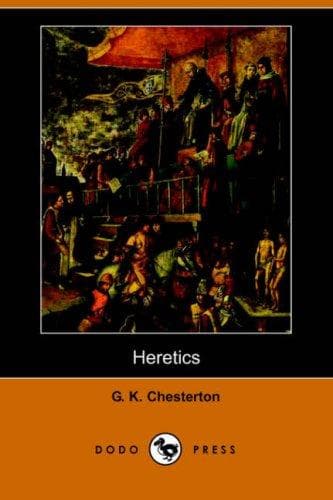
Apologetics; Chesterton, G. K. (Gilbert Keith), 1874-1936
Of real sensational journalism, as it exists in France, in Ireland, and
in America, we have no trace in this country. When a journalist in
Ireland wishes to create a thrill, he creates a thrill worth talking
about. He denounces a leading Irish member for corruption, or he
charges the whole police system with a wicked and definite conspiracy.
When a French journalist desires a frisson there is a frisson; he
discovers, let us say, that the President of the Republic has murdered
three wives. Our yellow journalists invent quite as unscrupulously as
this; their moral condition is, as regards careful veracity, about the
same. But it is their mental calibre which happens to be such that they
can only invent calm and even reassuring things. The fictitious version
of the massacre of the envoys of Pekin was mendacious, but it was not
interesting, except to those who had private reasons for terror or
sorrow. It was not connected with any bold and suggestive view of the
Chinese situation. It revealed only a vague idea that nothing could be
impressive except a great deal of blood. Real sensationalism, of which
I happen to be very fond, may be either moral or immoral. But even when
it is most immoral, it requires moral courage. For it is one of the
most dangerous things on earth genuinely to surprise anybody. If you
make any sentient creature jump, you render it by no means improbable
that it will jump on you. But the leaders of this movement have no
moral courage or immoral courage; their whole method consists in
saying, with large and elaborate emphasis, the things which everybody
else says casually, and without remembering what they have said. When
they brace themselves up to attack anything, they never reach the point
of attacking anything which is large and real, and would resound with
the shock. They do not attack the army as men do in France, or the
judges as men do in Ireland, or the democracy itself as men did in
England a hundred years ago. They attack something like the War
Office—something, that is, which everybody attacks and nobody bothers
to defend, something which is an old joke in fourth-rate comic papers.
Just as a man shows he has a weak voice by straining it to shout, so
they show the hopelessly unsensational nature of their minds when they
really try to be sensational. With the whole world full of big and
dubious institutions, with the whole wickedness of civilization staring
them in the face, their idea of being bold and bright is to attack the
War Office. They might as well start a campaign against the weather, or
form a secret society in order to make jokes about mothers-in-law. Nor
is it only from the point of view of particular amateurs of the
sensational such as myself, that it is permissible to say, in the words
of Cowper’s Alexander Selkirk, that “their tameness is shocking to me.”
The whole modern world is pining for a genuinely sensational
journalism. This has been discovered by that very able and honest
journalist, Mr.
Public-domain text, read in full here on John Shaqi.
Reviews
Reviews
No reviews yet
Be the first to share your thoughts on this work.
Join the Discussion
Join the discussion
Sign in to leave a comment or review.
Sign InorCreate an account