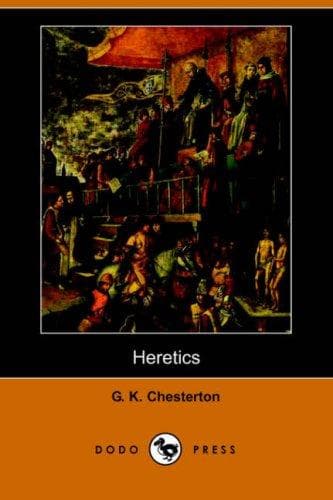
Apologetics; Chesterton, G. K. (Gilbert Keith), 1874-1936
will be difficult for any one to deny.
The theory of the unmorality of art has established itself firmly in
the strictly artistic classes. They are free to produce anything they
like. They are free to write a “Paradise Lost” in which Satan shall
conquer God. They are free to write a “Divine Comedy” in which heaven
shall be under the floor of hell. And what have they done? Have they
produced in their universality anything grander or more beautiful than
the things uttered by the fierce Ghibbeline Catholic, by the rigid
Puritan schoolmaster? We know that they have produced only a few
roundels. Milton does not merely beat them at his piety, he beats them
at their own irreverence. In all their little books of verse you will
not find a finer defiance of God than Satan’s. Nor will you find the
grandeur of paganism felt as that fiery Christian felt it who described
Faranata lifting his head as in disdain of hell. And the reason is very
obvious. Blasphemy is an artistic effect, because blasphemy depends
upon a philosophical conviction. Blasphemy depends upon belief and is
fading with it. If any one doubts this, let him sit down seriously and
try to think blasphemous thoughts about Thor. I think his family will
find him at the end of the day in a state of some exhaustion.
Neither in the world of politics nor that of literature, then, has the
rejection of general theories proved a success. It may be that there
have been many moonstruck and misleading ideals that have from time to
time perplexed mankind. But assuredly there has been no ideal in
practice so moonstruck and misleading as the ideal of practicality.
Nothing has lost so many opportunities as the opportunism of Lord
Rosebery. He is, indeed, a standing symbol of this epoch—the man who
is theoretically a practical man, and practically more unpractical than
any theorist. Nothing in this universe is so unwise as that kind of
worship of worldly wisdom. A man who is perpetually thinking of whether
this race or that race is strong, of whether this cause or that cause
is promising, is the man who will never believe in anything long enough
to make it succeed. The opportunist politician is like a man who should
abandon billiards because he was beaten at billiards, and abandon golf
because he was beaten at golf. There is nothing which is so weak for
working purposes as this enormous importance attached to immediate
victory. There is nothing that fails like success.
Public-domain text, read in full here on John Shaqi.
Reviews
Reviews
No reviews yet
Be the first to share your thoughts on this work.
Join the Discussion
Join the discussion
Sign in to leave a comment or review.
Sign InorCreate an account