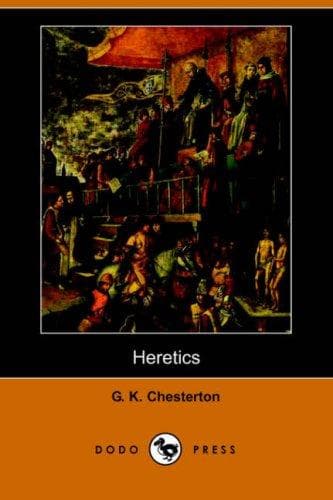
Apologetics; Chesterton, G. K. (Gilbert Keith), 1874-1936
We can see this change, for instance, in the modern transformation of
the thing called a club. When London was smaller, and the parts of
London more self-contained and parochial, the club was what it still is
in villages, the opposite of what it is now in great cities. Then the
club was valued as a place where a man could be sociable. Now the club
is valued as a place where a man can be unsociable. The more the
enlargement and elaboration of our civilization goes on the more the
club ceases to be a place where a man can have a noisy argument, and
becomes more and more a place where a man can have what is somewhat
fantastically called a quiet chop. Its aim is to make a man
comfortable, and to make a man comfortable is to make him the opposite
of sociable. Sociability, like all good things, is full of
discomforts, dangers, and renunciations. The club tends to produce the
most degraded of all combinations—the luxurious anchorite, the man who
combines the self-indulgence of Lucullus with the insane loneliness of
St. Simeon Stylites.
If we were to-morrow morning snowed up in the street in which we live,
we should step suddenly into a much larger and much wilder world than
we have ever known. And it is the whole effort of the typically modern
person to escape from the street in which he lives. First he invents
modern hygiene and goes to Margate. Then he invents modern culture and
goes to Florence. Then he invents modern imperialism and goes to
Timbuctoo. He goes to the fantastic borders of the earth. He pretends
to shoot tigers. He almost rides on a camel. And in all this he is
still essentially fleeing from the street in which he was born; and of
this flight he is always ready with his own explanation. He says he is
fleeing from his street because it is dull; he is lying. He is really
fleeing from his street because it is a great deal too exciting. It is
exciting because it is exacting; it is exacting because it is alive. He
can visit Venice because to him the Venetians are only Venetians; the
people in his own street are men. He can stare at the Chinese because
for him the Chinese are a passive thing to be stared at; if he stares
at the old lady in the next garden, she becomes active. He is forced to
flee, in short, from the too stimulating society of his equals—of free
men, perverse, personal, deliberately different from himself. The
street in Brixton is too glowing and overpowering. He has to soothe and
quiet himself among tigers and vultures, camels and crocodiles. These
creatures are indeed very different from himself. But they do not put
their shape or colour or custom into a decisive intellectual
competition with his own. They do not seek to destroy his principles
and assert their own; the stranger monsters of the suburban street do
seek to do this. The camel does not contort his features into a fine
sneer because Mr. Robinson has not got a hump; the cultured gentleman
at No.
Public-domain text, read in full here on John Shaqi.
Reviews
Reviews
No reviews yet
Be the first to share your thoughts on this work.
Elsewhere in the archive
Join the Discussion
Join the discussion
Sign in to leave a comment or review.
Sign InorCreate an account