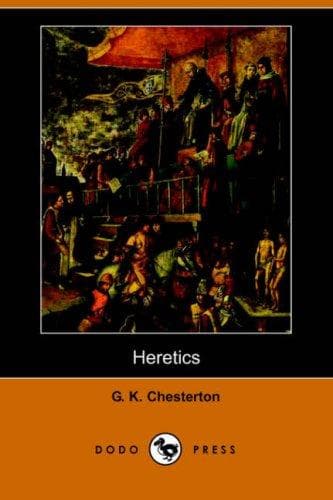
Apologetics; Chesterton, G. K. (Gilbert Keith), 1874-1936
5 does exhibit a sneer because Robinson has not got a dado. The
vulture will not roar with laughter because a man does not fly; but the
major at No. 9 will roar with laughter because a man does not smoke.
The complaint we commonly have to make of our neighbours is that they
will not, as we express it, mind their own business. We do not really
mean that they will not mind their own business. If our neighbours did
not mind their own business they would be asked abruptly for their
rent, and would rapidly cease to be our neighbours. What we really mean
when we say that they cannot mind their own business is something much
deeper. We do not dislike them because they have so little force and
fire that they cannot be interested in themselves. We dislike them
because they have so much force and fire that they can be interested in
us as well. What we dread about our neighbours, in short, is not the
narrowness of their horizon, but their superb tendency to broaden it.
And all aversions to ordinary humanity have this general character.
They are not aversions to its feebleness (as is pretended), but to its
energy. The misanthropes pretend that they despise humanity for its
weakness. As a matter of fact, they hate it for its strength.
Of course, this shrinking from the brutal vivacity and brutal variety
of common men is a perfectly reasonable and excusable thing as long as
it does not pretend to any point of superiority. It is when it calls
itself aristocracy or aestheticism or a superiority to the bourgeoisie
that its inherent weakness has in justice to be pointed out.
Fastidiousness is the most pardonable of vices; but it is the most
unpardonable of virtues. Nietzsche, who represents most prominently
this pretentious claim of the fastidious, has a description
somewhere—a very powerful description in the purely literary sense—of
the disgust and disdain which consume him at the sight of the common
people with their common faces, their common voices, and their common
minds. As I have said, this attitude is almost beautiful if we may
regard it as pathetic. Nietzsche’s aristocracy has about it all the
sacredness that belongs to the weak. When he makes us feel that he
cannot endure the innumerable faces, the incessant voices, the
overpowering omnipresence which belongs to the mob, he will have the
sympathy of anybody who has ever been sick on a steamer or tired in a
crowded omnibus. Every man has hated mankind when he was less than a
man. Every man has had humanity in his eyes like a blinding fog,
humanity in his nostrils like a suffocating smell. But when Nietzsche
has the incredible lack of humour and lack of imagination to ask us to
believe that his aristocracy is an aristocracy of strong muscles or an
aristocracy of strong wills, it is necessary to point out the truth. It
is an aristocracy of weak nerves.
Public-domain text, read in full here on John Shaqi.
Reviews
Reviews
No reviews yet
Be the first to share your thoughts on this work.
Elsewhere in the archive
Join the Discussion
Join the discussion
Sign in to leave a comment or review.
Sign InorCreate an account