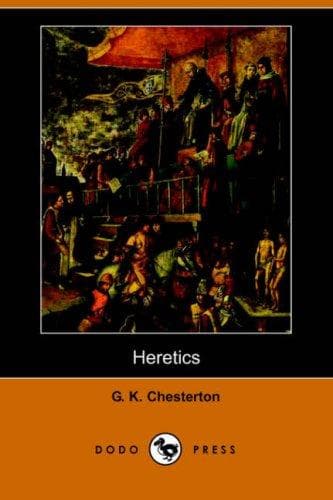
Apologetics; Chesterton, G. K. (Gilbert Keith), 1874-1936
devotes so much serious and sympathetic study to the man called
Tristram of Blent, a man who throughout burning boyhood thought of
nothing but a silly old estate, we feel even in Mr. Hope the hint of
this excessive concern about the oligarchic idea. It is hard for any
ordinary person to feel so much interest in a young man whose whole aim
is to own the house of Blent at the time when every other young man is
owning the stars.
Mr. Hope, however, is a very mild case, and in him there is not only an
element of romance, but also a fine element of irony which warns us
against taking all this elegance too seriously. Above all, he shows his
sense in not making his noblemen so incredibly equipped with impromptu
repartee. This habit of insisting on the wit of the wealthier classes
is the last and most servile of all the servilities. It is, as I have
said, immeasurably more contemptible than the snobbishness of the
novelette which describes the nobleman as smiling like an Apollo or
riding a mad elephant. These may be exaggerations of beauty and
courage, but beauty and courage are the unconscious ideals of
aristocrats, even of stupid aristocrats.
The nobleman of the novelette may not be sketched with any very close
or conscientious attention to the daily habits of noblemen. But he is
something more important than a reality; he is a practical ideal. The
gentleman of fiction may not copy the gentleman of real life; but the
gentleman of real life is copying the gentleman of fiction. He may not
be particularly good-looking, but he would rather be good-looking than
anything else; he may not have ridden on a mad elephant, but he rides a
pony as far as possible with an air as if he had. And, upon the whole,
the upper class not only especially desire these qualities of beauty
and courage, but in some degree, at any rate, especially possess them.
Thus there is nothing really mean or sycophantic about the popular
literature which makes all its marquises seven feet high. It is
snobbish, but it is not servile. Its exaggeration is based on an
exuberant and honest admiration; its honest admiration is based upon
something which is in some degree, at any rate, really there. The
English lower classes do not fear the English upper classes in the
least; nobody could. They simply and freely and sentimentally worship
them. The strength of the aristocracy is not in the aristocracy at all;
it is in the slums. It is not in the House of Lords; it is not in the
Civil Service; it is not in the Government offices; it is not even in
the huge and disproportionate monopoly of the English land. It is in a
certain spirit. It is in the fact that when a navvy wishes to praise a
man, it comes readily to his tongue to say that he has behaved like a
gentleman. From a democratic point of view he might as well say that
he had behaved like a viscount. The oligarchic character of the modern
English commonwealth does not rest, like many oligarchies, on the
cruelty of the rich to the poor.
Public-domain text, read in full here on John Shaqi.
Reviews
Reviews
No reviews yet
Be the first to share your thoughts on this work.
Elsewhere in the archive
Join the Discussion
Join the discussion
Sign in to leave a comment or review.
Sign InorCreate an account