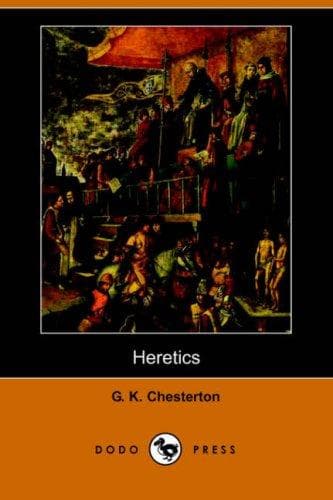
Apologetics; Chesterton, G. K. (Gilbert Keith), 1874-1936
The element of oligarchical sentiment in these novels, however, has, I
think, another and subtler aspect, an aspect more difficult to
understand and more worth understanding. The modern gentleman,
particularly the modern English gentleman, has become so central and
important in these books, and through them in the whole of our current
literature and our current mode of thought, that certain qualities of
his, whether original or recent, essential or accidental, have altered
the quality of our English comedy. In particular, that stoical ideal,
absurdly supposed to be the English ideal, has stiffened and chilled
us. It is not the English ideal; but it is to some extent the
aristocratic ideal; or it may be only the ideal of aristocracy in its
autumn or decay. The gentleman is a Stoic because he is a sort of
savage, because he is filled with a great elemental fear that some
stranger will speak to him. That is why a third-class carriage is a
community, while a first-class carriage is a place of wild hermits. But
this matter, which is difficult, I may be permitted to approach in a
more circuitous way.
The haunting element of ineffectualness which runs through so much of
the witty and epigrammatic fiction fashionable during the last eight or
ten years, which runs through such works of a real though varying
ingenuity as “Dodo,” or “Concerning Isabel Carnaby,” or even “Some
Emotions and a Moral,” may be expressed in various ways, but to most of
us I think it will ultimately amount to the same thing. This new
frivolity is inadequate because there is in it no strong sense of an
unuttered joy. The men and women who exchange the repartees may not
only be hating each other, but hating even themselves. Any one of them
might be bankrupt that day, or sentenced to be shot the next. They are
joking, not because they are merry, but because they are not; out of
the emptiness of the heart the mouth speaketh. Even when they talk pure
nonsense it is a careful nonsense—a nonsense of which they are
economical, or, to use the perfect expression of Mr. W. S. Gilbert in
“Patience,” it is such “precious nonsense.” Even when they become
light-headed they do not become light-hearted. All those who have read
anything of the rationalism of the moderns know that their Reason is a
sad thing. But even their unreason is sad.
Public-domain text, read in full here on John Shaqi.
Reviews
Reviews
No reviews yet
Be the first to share your thoughts on this work.
Elsewhere in the archive
Join the Discussion
Join the discussion
Sign in to leave a comment or review.
Sign InorCreate an account