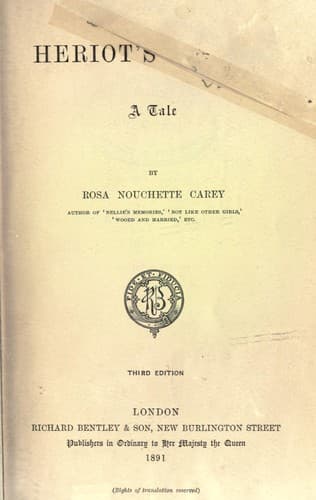
England -- Social life and customs -- 19th century -- Fiction; Families -- Fiction
'Their ignorance and hard-headedness are lamentable,' groaned Hugh;
'dissent has a terrible hold over their mind; but to judge from a few of
the stories Mr. Delaware tells us, things are better than they were.'
'My father met with a curious instance of this crass ignorance on the
part of one of his parishioners about fifteen years ago,' returned
Richard. 'I have heard him relate it so often. You remember old W----,
father?'
'I am not likely to forget him,' replied Mr. Lambert, smiling. 'It was a
very pitiful case to my mind, though one cannot forbear a smile at the
quaintness of his notion. Heriot has often heard me refer to it.'
'We must have it for Marsden's benefit then.'
'I think Richard was right in saying that it was about fifteen years ago
that I was called to minister to an old man in his eighty-sixth year,
who had been blind from his birth, I believe, and was then on his
deathbed. I read to him, prayed for him, and talked to him; but though
his lips moved I did not seem to gain his attention. At last, in
despair, I said good-afternoon, and rose to go, but he suddenly caught
hold of me.
'"Stop ye, parson," he said; "stop ye a bit, an' just hear me say my
prayers, will ye?" I thought it a singular request, but I remained, and
he began repeating the Lord's Prayer, the Creed, the collect "Lighten
our darkness," and finished up with the quaint old couplet beginning--
"Matthew, Mark, Luke, and John,
Bless the bed that I lie on,"
and after he had finished he said triumphantly, "Hoo d'ye think I've
deean?" I said, "em gay weel. D'ye think I'll pass?"
'Of course I said something appropriate in reply; but his attention
seemed wholly fixed on the fact that he could say his prayers correctly,
as he had been probably taught in his early childhood, and when I had
noticed his lips moving he had been conning the prayers over to himself
before repeating them for my judgment.'[3]
[Footnote 3: Taken from fact.]
A lugubrious shake of the head was Hugh's only answer.
'I grant you such a state of things seems almost incredible in our
enlightened nineteenth century,' continued Mr. Lambert, 'but many of my
older brethren have curious stories to tell of their parishioners, all
of them rather amusing than otherwise. Your predecessor, Heriot--Dr.
Bailey--had a rare stock of racy anecdotes, with which he used to
entertain us on winter evenings over a glass of hot whisky toddy.'
'To which he was slightly too much addicted,' observed Dr. Heriot.
'Well, well, we all have our faults,' replied the vicar, charitably. 'We
will not speak against poor Bailey, who was in the main a downright
honest fellow, though he was not without his weakness. Betha used to
remonstrate with him sometimes, but it was no use; he said he was too
old to break off a habit. I don't think, Heriot, he ever went to great
lengths.'
'Possibly not,' was the somewhat dry reply, 'but we are willing to be
amused by the old doctor's reminiscences.'
Public-domain text, read in full here on John Shaqi.
Reviews
Reviews
No reviews yet
Be the first to share your thoughts on this work.
Elsewhere in the archive
Join the Discussion
Join the discussion
Sign in to leave a comment or review.
Sign InorCreate an account