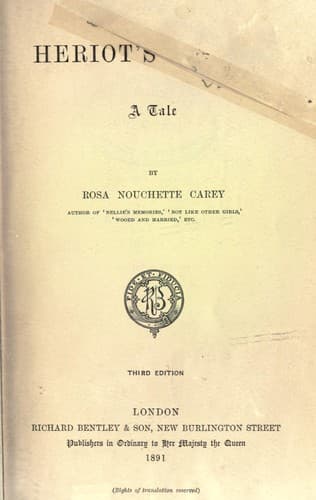
England -- Social life and customs -- 19th century -- Fiction; Families -- Fiction
'You know the old Westmorland custom for giving names; well, some forty
years ago George Bailey, then a young doctor new to practice, was sent
for to visit a man named John Atkinson, who lived in a house at the head
of Swale-dale.
'Having reached the place, he knocked at the door, and asked if John
Atkinson lived there.
'"Nay," says the woman, "we've naebody ev that nyam hereaboots."
'"What?" says Bailey, "nobody of the name in the dale?"
'"Nyah," was the reply, made with the usual phlegm and curtness of the
genuine Daleswoman. "There's naebody ev that nyam."
'"Well, it is very odd," returned Bailey, in great perplexity. "This
looks like the house to which I was directed. Is there any one ill in
the dale?"
'"Bless me, bairn," exclaimed the woman, "ye'll mean lile Geordie John.
He's my man; en's liggen en theyar," pointing to an inner room, "varra
badly. Ye'll be t'doctor, I warn't. Cum, cum yer ways in en see him. Noo
I think on't, his reet nyam is John Atkinson, byt he allus gas by lile
Geordie John. His fad'r was Geordie, ye kna, an' nobbut a varra lile
chap."'
'Capital!' observed Dr. Heriot, as he chuckled and rubbed his hands over
this story. 'Bailey told it with spirit, I'll be bound. How well you
have mastered the dialect, Mr. Lambert.'
'I made it my study when I first came here. Betha and I found a fund
of amusement in it. Have you ever noticed, Heriot, there is a dry,
heavy sort of wit--a certain richness and appropriateness of
language--employed by some of these Dalesmen, if one severs the grain
from the rough husk?'
'They are not wanting in character or originality certainly, though they
are often as rugged as their own hills. I fancy Bailey had lived among
them till he had grown to regard them as the finest people and the best
society in the world.'
'I should not wonder. I remember he told me once that he was called to a
place in Orton to see an elderly man who was sick. "Well, Betty," he
said to the wife, "how's Willy?"
'"Why," says Betty, "I nau'nt; he's been grumbling for a few days back,
and yesterday he tyak his bed. I thout I'd send for ye. He mebbe git'nt
en oot heat or summat; byt gang ye in and see him." The doctor having
made the necessary examination came out of the sickroom, and Betty
followed him.
'"Noo, doctor, hoo div ye find him?"
'"Well, Betty, he's very bad."
'"Ye dunnot say he's gangen t'dee?"
'"Well," returned Bailey, reluctantly, "I think it is not unlikely; to
my thinking he cannot pull through."
'"Oh, dear me," sighed Betty, "poor auld man. He's ben a varra good man
t'me, en I'll be wa to looes him, byt we mun aw gang when oor time cums.
Ye'll cum agen, doctor, en deeah what ye can for hym. We been lang
t'gither, Willy an me, that ha' we."
'Well, Bailey continued his visits every alternate day, giving no hope,
and on one Monday apprising her that he thought Willy could not last
long.
Public-domain text, read in full here on John Shaqi.
Reviews
Reviews
No reviews yet
Be the first to share your thoughts on this work.
Elsewhere in the archive
Join the Discussion
Join the discussion
Sign in to leave a comment or review.
Sign InorCreate an account