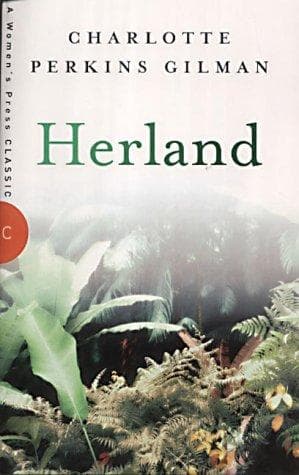
Black humor; Utopian fiction; Utopias -- Fiction; Women -- Fiction
“What became of them?” asked Jeff.
“We do not want them anymore. They took up too much room--we need all
our land to feed our people. It is such a little country, you know.”
“Whatever do you do without milk?” Terry demanded incredulously.
“_Milk?_ We have milk in abundance--our own.”
“But--but--I mean for cooking--for grown people,” Terry blundered, while
they looked amazed and a shade displeased.
Jeff came to the rescue. “We keep cattle for their milk, as well as
for their meat,” he explained. “Cow’s milk is a staple article of diet.
There is a great milk industry--to collect and distribute it.”
Still they looked puzzled. I pointed to my outline of a cow. “The farmer
milks the cow,” I said, and sketched a milk pail, the stool, and in
pantomime showed the man milking. “Then it is carried to the city and
distributed by milkmen--everybody has it at the door in the morning.”
“Has the cow no child?” asked Somel earnestly.
“Oh, yes, of course, a calf, that is.”
“Is there milk for the calf and you, too?”
It took some time to make clear to those three sweet-faced women the
process which robs the cow of her calf, and the calf of its true food;
and the talk led us into a further discussion of the meat business. They
heard it out, looking very white, and presently begged to be excused.
CHAPTER 5.
A Unique History
It is no use for me to try to piece out this account with adventures.
If the people who read it are not interested in these amazing women and
their history, they will not be interested at all.
As for us--three young men to a whole landful of women--what could we
do? We did get away, as described, and were peacefully brought back
again without, as Terry complained, even the satisfaction of hitting
anybody.
There were no adventures because there was nothing to fight. There were
no wild beasts in the country and very few tame ones. Of these I might
as well stop to describe the one common pet of the country. Cats, of
course. But such cats!
What do you suppose these Lady Burbanks had done with their cats? By the
most prolonged and careful selection and exclusion they had developed a
race of cats that did not sing! That’s a fact. The most those poor dumb
brutes could do was to make a kind of squeak when they were hungry or
wanted the door open, and, of course, to purr, and make the various
mother-noises to their kittens.
Moreover, they had ceased to kill birds. They were rigorously bred to
destroy mice and moles and all such enemies of the food supply; but the
birds were numerous and safe.
While we were discussing birds, Terry asked them if they used feathers
for their hats, and they seemed amused at the idea. He made a few
sketches of our women’s hats, with plumes and quills and those various
tickling things that stick out so far; and they were eagerly interested,
as at everything about our women.
Public-domain text, read in full here on John Shaqi.
Reviews
Reviews
No reviews yet
Be the first to share your thoughts on this work.
Join the Discussion
Join the discussion
Sign in to leave a comment or review.
Sign InorCreate an account