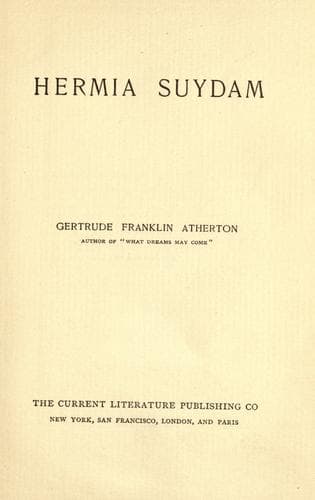
Hermia leaned back against a pile of cushions, and, clasping her hands
behind her head, gazed about her with half-closed eyes. There was a
sense of familiarity about it all that cast a shadow over her content.
It was a remarkably close reproduction of an ideal, considering that the
ideal had been filtered through the practical brain of a nineteenth
century decorator—but therein lay the sting. She had dreamed of this
room, lived in it; it was as familiar as Bessie’s parlor in Brooklyn,
with its tidies and what-nots; it wanted the charm of novelty. She had a
protesting sense of being defrauded; it was all very well to realize
one’s imaginings, but how much sweeter if some foreign hand had
cunningly woven details within and glamour above, of which she had never
dreamed. The supreme delight of atmospheric architecture is the vague,
abiding sense that high on the pinnacle we have reared, and which has
shot above vision’s range, is a luminous apex, divine in color, wondrous
in form, a will-o’-the-wisp fluttering in the clouds of imagination.
Hermia sighed, but shrugged her shoulders. Had not life taught her
philosophy?
Where the gold-stuffs parted on the wall opposite the pillars, a mirror,
ivory-framed, reached from floor to ceiling. Hermia rose and walked a
few steps toward the glass without daring to raise her eyes. Then with a
little cry she ran to the lamps and turned them out. She flung off her
clothes, threw the lace thing she called her night-gown over her head,
and jumped into bed. She pulled the covers over her face, and for ten
minutes lay and reviled herself. Then, with an impatient and audible
exclamation at her cowardice, she got up and lit every lamp in the room.
She walked over to the mirror and looked long at herself, fearfully at
first, then gravely, at last smilingly. She was beautiful, because she
was unique. Her victory was the more assured because her beauty would be
the subject of many a dispute. She had not the delicate features and
conventional coloring that women admire, but a certain stormy, reckless
originality which would appeal swiftly and directly to variety-loving
man. Her eyes, clear and brilliant as they had once been dull and cold,
were deep and green as the sea. Her hair, which lay in a wiry cloud
about her head and swept her brows, was a shining mass of brazen
threads. Her complexion had acquired the clear tint of ivory and was
stained with the rich hue of health. The very expression of her face had
changed; the hard, dogged, indifferent look had fled. With hope and
health and wishes gratified had come the lifting and banishment of the
old mask—that crystallization of her spirit’s discontent. Yes, she was
a beautiful woman. She might not have a correct profile or a soft
roundness of face, but she was a beautiful woman.
Public-domain text, read in full here on John Shaqi.
Reviews
Reviews
No reviews yet
Be the first to share your thoughts on this work.
Join the Discussion
Join the discussion
Sign in to leave a comment or review.
Sign InorCreate an account