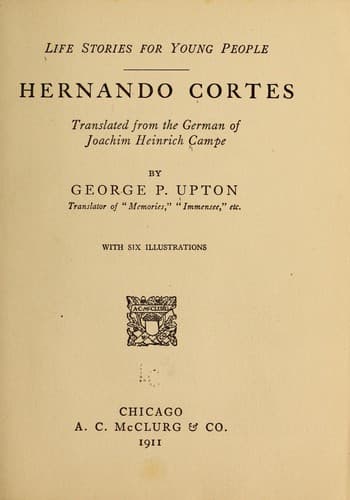
Cortés, Hernán, 1485-1547 -- Juvenile literature; Mexico -- History -- Conquest, 1519-1540 -- Juvenile literature
Cortes accepted these splendid gifts with expressions of the utmost
respect for the giver, and thereupon the ambassadors proceeded to the
disagreeable part of their commission. They declared on behalf of their
sovereign that he could not permit foreign soldiers to approach the
capital or remain longer within the limits of the Mexican Empire. They
were requested to retire immediately. Fair and reasonable as the request
was, Cortes assumed the mien of one who had been insulted, and asserted
even more haughtily than before that he utterly refused to accept the
reply, for his own honor and that of his sovereign would be offended
should he return without having had the interview. The eyes of the
Mexicans, who were accustomed to abject submission to their ruler, were
fixed in astonishment upon a man who dared to resist anything which
their absolute lord had ordered. Such audacity was so terrible to them
that it was some time before they could recover from the shock. At last
they regained composure and begged of this bold European a second delay
in order to report his unexpected persistency at the capital. Cortes
again consented, but upon the condition that he should not have to wait
too long for a reply. Firm and decided as he appeared to be in these
negotiations, he was not altogether sure that he was on secure ground.
Everything convinced him that he had to deal with a powerful and well
managed government. It seemed the most hazardous thing in the world to
oppose such a power with a handful of Spanish adventurers.
Nevertheless he held to the bold purpose of venturing the undertaking,
cost what it might. Two motives actuated him. Religious zeal was the
first. He was convinced he would be doing Heaven a great service if he
could convert these heathen to Christianity. The second was based on his
own doubtful circumstances, for, after what had occurred between himself
and Velasquez, the governor, upon leaving Cuba, he could not hope to
escape unpunished when he returned. As his life was in danger in any
event, he might better risk it in the accomplishment of an unheard of
adventure than expose himself to the danger of losing it at the hands of
the hangman upon his return. Unfortunately there were several in his
army who were growing very anxious, and these were men who were more
closely attached to Velasquez than to him. They had used their utmost
efforts to disaffect the others and to excite a general uprising so as
to force their leader to return to Cuba. But the prospect of securing
vast and exhaustless treasures was so strong that nothing else could
make a deep impression upon them. Besides, they believed there was good
reason now to expect a favorable answer from Mexico.
Public-domain text, read in full here on John Shaqi.
Reviews
Reviews
No reviews yet
Be the first to share your thoughts on this work.
Join the Discussion
Join the discussion
Sign in to leave a comment or review.
Sign InorCreate an account