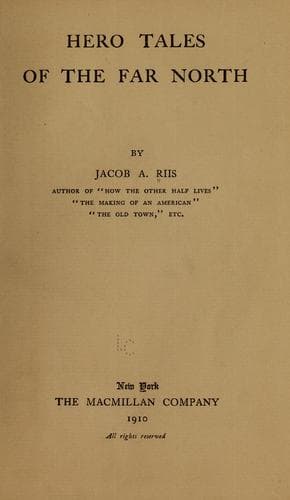
Hero Tales of the Far NorthRiis, Jacob A. (Jacob August)
History
Hero Tales of the Far North
Riis, Jacob A. (Jacob August)
Scandinavia -- History
Famous as he had become, he found the first stretch of the row at
home a hard one to hoe. His books brought him no income. Nobody
would employ him, “even for a sick servant,” he complained. Envious
rivals assailed him and his botany, and there were days when
herring and black bread was fare not to be despised in Dr. Linnæus’
household. But he kept pegging away and his luck changed. One
well-to-do patient brought another, and at last the queen herself
was opportunely seized with a bad cough. She saw one of her ladies
take a pill and asked what it was. Dr. Linnæus’ prescription for
a cold, she said, and it always cured her right up. So the doctor
was called to the castle and his cure worked there, too. Not long
after that he set down in his diary that “Now, no one can get well
without my help.”
But he was not happy. “Once, I had flowers and no money,” he
said; “now, I have money and no flowers.” That they appointed him
professor of medicine at Upsala did not mend matters. His lectures
were popular and full of common sense. Diet and the simple life
were his hobbies, temperance in all things. He ever insisted that
where one man dies from drinking too much, ten die from overeating.
Children should eat four times a day, grown-ups twice, was his
rule. The foolish fashions and all luxury he abhorred. He himself
in his most famous years lived so plainly that some said he was
miserly, and his clothes were sometimes almost shabby. The happiest
day of his life came when he and his old enemy Rosén, whom he found
filling the chair of botany at the university, and with whom he
made it up soon after they became fellow members of the faculty,
exchanged chairs with the ready consent of the authorities. So, at
last, Linnæus had attained the place he coveted above all others,
and the goal of his ambition was reached.
He lived at Upsala thirty-seven years and wrote many books. His
students idolized him. They came from all over the world. Twice a
week in summer, on Wednesday and Saturday, they sallied forth with
him to botanize in field and forest, and when they had collected
specimens all the long day they escorted the professor home through
the twilight streets with drums and trumpets and with flowers
in their hats. But however late they left him at his door, the
earliest dawn saw him up and at his work, for the older he grew the
more precious the hours that remained. In summer he was accustomed
to rise at three o’clock; in the dark winter days at six.
Public-domain text, read in full here on John Shaqi.
Reviews
Reviews
No reviews yet
Be the first to share your thoughts on this work.
Elsewhere in the archive
Join the Discussion
Join the discussion
Sign in to leave a comment or review.
Sign InorCreate an account