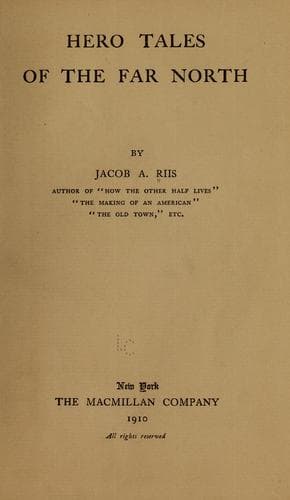
Hero Tales of the Far NorthRiis, Jacob A. (Jacob August)
History
Hero Tales of the Far North
Riis, Jacob A. (Jacob August)
Scandinavia -- History
He found biology a chaos and left it a science. In his special
field of botany he was not, as some think, the first. He himself
catalogued fully a thousand books on his topic. But he brought
order into it; he took what was good and, rejecting the false,
fashioned it into a workable system. In the mere matter of
nomenclature, his way of calling plants, like men, by a family name
and a given name wrought a change hard to appreciate in our day.
The common blue grass of our lawns, for instance, he called, and we
call it still, _Poa pratensis_. Up to his time it had three names
and one of them was _Gramen pratense paniculatum majus latiore
folio poa theophrasti_. Dr. Rydberg, of the New York Botanical
Gardens, said aptly at the bicentenary of his birth, that it was
as if instead of calling a girl Grace Darling one were to say “Mr.
Darling’s beautiful, slender, graceful, blue-eyed girl with long,
golden curls and rosy cheeks.”
The binomial system revolutionized the science. What the lines
of longitude and latitude did for geography Linnæus’ genius did
for botany. And he did not let pride of achievement persuade him
that he had said the last word. He knew his system to be the best
till some one should find a better, and said so. The King gave him
a noble name and he was proud of it with reason—vain, some have
said. But vanity did not make the creature deny the Creator. He
ever tried to trace science to its author. When the people were
frightened by the “water turning to blood” and overzealous priests
cried that it was a sign of the wrath of God, he showed under the
magnifying glass the presence of innumerable little animals that
gave the water its reddish tinge, and thereby gave offence to some
pious souls. But over the door of his lecture room were the words
in Latin: “Live guiltless—God sees you!” and in his old age, seeing
with prophetic eye the day of bacteriology that dawned a hundred
years after his death, he thanked God that He had permitted him to
“look into His secret council room and workshop.”
He was one of the clear thinkers of all days, uniting imagination
with sound sense. It was Linnæus who discovered that plants sleep
like animals. The Pope ordered that his books, wherever they were
found in his dominions, should be burned as materialistic and
heretical; but Linnæus lived to see a professor in botany at Rome
dismissed because he did not understand his system, and another put
in his place who did, and whose lectures followed his theories.
When he was seventy he was stricken with apoplexy, while lecturing
to his students, and the last year of his life was full of misery.
“Linnæus limps,” is one of the last entries in his diary, “can
hardly walk, speaks unintelligibly, and is scarce able to write.”
Death came on January 10, 1778.
Public-domain text, read in full here on John Shaqi.
Reviews
Reviews
No reviews yet
Be the first to share your thoughts on this work.
Elsewhere in the archive
Join the Discussion
Join the discussion
Sign in to leave a comment or review.
Sign InorCreate an account