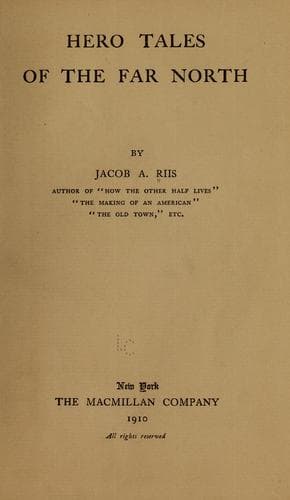
Hero Tales of the Far NorthRiis, Jacob A. (Jacob August)
History
Hero Tales of the Far North
Riis, Jacob A. (Jacob August)
Scandinavia -- History
Undismayed, Bengerd objects that Danish women have no business
to wear silken gowns, and that a good horse is not for a peasant
lad. The King replies patiently that what a woman can buy she may
wear for him, and that he will not take the lad’s horse if he can
feed it. Bengerd is not satisfied. “Let bar the land with iron
chains” is her next proposal, that neither man nor woman enter
it without paying tax. Her husband says scornfully that Danish
kings have never had need of such measures, and never will. He is
plainly getting bored, and when she keeps it up, and begrudges the
husbandman more than “two oxen and a cow,” he loses his temper, and
presumably there is a matrimonial tiff. Very likely most of this is
fiction, bred of the popular prejudice. The King loved her, that
is certain. She was a beautiful high-spirited woman, so beautiful
that many hundreds of years after, when her grave was opened, the
delicate oval of her skull excited admiration yet. But the people
hated her. Twenty generations after her death it was their custom
when passing her grave to spit on it with the exclamation “Out upon
thee, Bengerd! God bless the King of Denmark”; for in good or evil
days they never wavered in their love and admiration for the king
who was a son of the first Valdemar, and the heir of his greatness
and of that of the sainted Absalon. Tradition has it that Bengerd
was killed in battle, having gone with her husband on one of his
campaigns. “It was not heard in any place,” says the folk-song
wickedly, “that any one grieved for her.” But the King mourned for
his beautiful queen to the end of his days.
Bengerd bore Valdemar three sons upon whom he lavished all the
affection of his lonely old age. Erik he chose as his successor,
and to keep his brothers loyal to him he gave them great fiefs and
thus, unknowing, brought on the very trouble he sought to avoid,
and set his foot on the path that led to Denmark’s dismemberment
after centuries of bloody wars. For to his second son Abel he gave
Slesvig, and Abel, when his brother became king, sought alliance
with the Holstein count Adolf,[10] the very one who had led the
Germans at the fatal battle of Bornhöved. The result was a war
between the brothers that raged seven years, and laid waste the
land. Worse was to follow, for Abel was only “Abel in name, but
Cain in deed.” But happily the old King’s eyes were closed then,
and he was spared the sight of one brother murdering the other for
the kingdom.
Public-domain text, read in full here on John Shaqi.
Reviews
Reviews
No reviews yet
Be the first to share your thoughts on this work.
Elsewhere in the archive
Join the Discussion
Join the discussion
Sign in to leave a comment or review.
Sign InorCreate an account