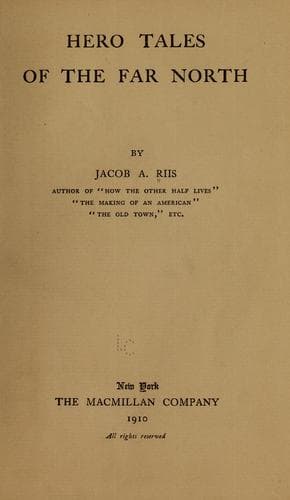
Hero Tales of the Far NorthRiis, Jacob A. (Jacob August)
History
Hero Tales of the Far North
Riis, Jacob A. (Jacob August)
Scandinavia -- History
Some foreboding of this seems to have troubled him in his last
years. It is related that once when he was mounting his horse to go
hunting he fell into a deep reverie, and remained standing with his
foot in the stirrup a long time, while his men wondered, not daring
to disturb him. At last one of them went to remind him that the
sun was low in the west. The King awoke from his dream, and bade
him go at once to a wise old hermit who lived in a distant part of
the country. “Ask him,” he said, “what King Valdemar was thinking
of just now, and bring me his answer.” The knight went away on his
strange errand, and found the hermit. And this was the message he
brought back: “Your lord and master pondered as he stood by his
horse, how his sons would fare when he was dead. Tell him that war
and discord they shall have, but kings they will all be.” When the
King heard the prophecy he was troubled in mind, and called his
sons and all his great knights to a council at which he pleaded
with them to keep the peace. But though they promised, he was
barely in his grave when riot and bloodshed filled the land. The
climax was reached when Abel inveigled his brother to his home with
fair words and, once he had him in his power, seized him and gave
him over to his men to do with “as they pleased.” They understood
their master only too well, and took King Erik out on the fjord in
an open boat, and killed him there, scarce giving him time to say
his prayers. They weighted his body with his helmet, and sank it in
the deep.
Abel made oath with four and twenty of his men that he was innocent
of his brother’s blood, and took the crown after him. But the foul
crime was soon avenged. Within a few years he was himself slain
by a peasant in a rising of his own people. For a while his body
lay unburied, the prey of beast and bird, and when it was interred
in the Slesvig cathedral there was no rest for it. “Such turmoil
arose in the church by night that the monks could not chant their
vigils,” and in the end they took him out, and buried him in a
swamp, with a stake driven through the heart to lay his ghost. But
clear down to our time when people ceased to believe in ghosts, the
fratricide was seen at night hunting through the woods, coal-black
and on a white horse, with three fiery dogs trailing after; and
blue flames burned over the sea where they vanished. That was how
the superstition of the people judged the man whom the nobles and
the priests made king, red-handed.
Christopher, the youngest of the three brothers, was king last.
His end was no better than that of the rest. Indeed, it was worse.
Hardly yet forty years old, he died—poisoned, it was said, by the
Abbot Arnfast, in the sacrament as he knelt at the altar-rail
in the Ribe cathedral. He was buried in the chancel where the
penitents going to the altar walk over his grave. So, of all
Valdemar’s four sons, not one died a peaceful, natural death. But
kings they all were.
Public-domain text, read in full here on John Shaqi.
Reviews
Reviews
No reviews yet
Be the first to share your thoughts on this work.
Elsewhere in the archive
Join the Discussion
Join the discussion
Sign in to leave a comment or review.
Sign InorCreate an account