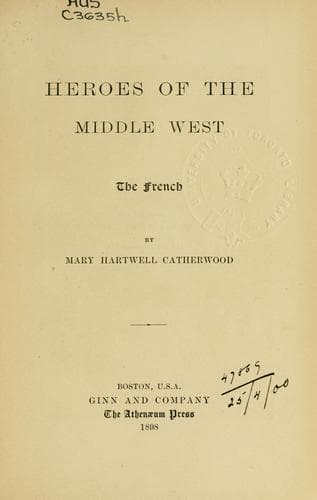
Heroes of the Middle West: The FrenchCatherwood, Mary Hartwell
History
Heroes of the Middle West: The French
Catherwood, Mary Hartwell
Mississippi River Valley -- Discovery and exploration; Mississippi River Valley -- History -- To 1803
The Illinois lodges were shaped like the rounded cover of an emigrant
wagon, high, and very long, having an opening left along the top for
the escape of smoke. They were made of rush mats, which the women wove,
overlapped as shingles on a framework of poles. Rush mats also carpeted
the ground, except where fires burned in a row along the middle. Each
fire was used by two families who lived opposite, in stalls made of
blankets. The ends of the lodge had flaps to shut out the weather, but
these were left wide open to the summer sun. During visits of ceremony a
guest stood where he could be seen and heard by all who could crowd into
the wigwam. But when the Illinois held important councils they made a
circular inclosure, and built a camp-fire in the center. Many families
and many fires filled a long wigwam, though Jolliet and Marquette were
lodged with the chief, who had one for himself and his household.
Whitening embers were sending threads of smoke towards a strip of blue
sky overhead when the missionary stood up to explain his errand in the
crowded inclosure, dividing his talk into four parts with presents.
By the first gift of cloth and beads he told his listeners that the
Frenchmen were voyaging in peace to visit nations on the river. By the
second he said:
"I declare to you that God, your Creator, has pity on you, since, when
you have been so long ignorant of him, he wishes to become known to you.
I am sent on his behalf with this design. It is for you to acknowledge
and obey him."
By the third gift they were informed that the chief of the French had
spread peace and overcome the Iroquois. And the last begged for all the
information they could give about the sea and intervening nations.
When Marquette sat down, the chief stood up and laid his hand on the
head of a little slave, prisoner from another tribe.
"I thank you, Blackgown," he said, "and you, Frenchman, for taking so
much pains to come and visit us. The earth has never been so beautiful,
nor the sun so bright, as to-day; never has the river been so calm and
free from rocks, which your canoes removed as they passed! Never has our
tobacco had so fine a flavor, nor our corn appeared so beautiful as we
find it to-day. Here is my son. I give him to you that you may know my
heart. Take pity on us and all our nation. You know the Great Spirit who
made all: you speak to him and hear him; ask him to give us life and
health and come and dwell with us."
Public-domain text, read in full here on John Shaqi.
Reviews
Reviews
No reviews yet
Be the first to share your thoughts on this work.
Join the Discussion
Join the discussion
Sign in to leave a comment or review.
Sign InorCreate an account