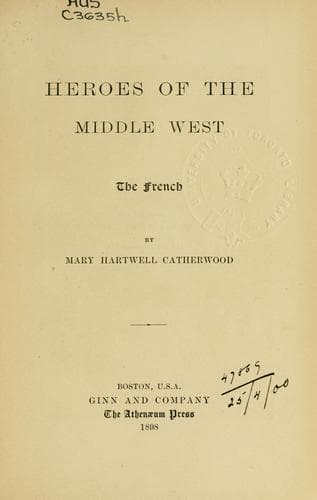
Heroes of the Middle West: The FrenchCatherwood, Mary Hartwell
History
Heroes of the Middle West: The French
Catherwood, Mary Hartwell
Mississippi River Valley -- Discovery and exploration; Mississippi River Valley -- History -- To 1803
They were gaunt and weather-beaten themselves from two years' tramping
the wilderness. But their eyes dwelt most piteously on the dying man
stretched in the bottom of the canoe. His thin fingers held a cross.
His white face and bright hair rested on a pile of blankets. Pierre and
Jacques felt that no lovelier, kinder being than this scarcely breathing
missionary would ever float on the blue water under that blue sky.
He opened his eyes and saw the creek they were slipping past, and a
pleasant knoll beside it, and whispered:--
"There is the place of my burial."
"But, Father," pleaded Pierre, "it is yet early in the day. We can take
you farther."
"Carry me ashore here," he whispered again.
So they entered the creek and took him ashore, building a fire and
sheltering him as well as they could. There a few hours afterward he
died, the weeping men holding up his cross before him, while he thanked
the Divine Majesty for letting him die a poor missionary. When he could
no longer speak, they repeated aloud the prayers he had taught them.
They left him buried on that shore with a large cross standing over his
grave. Later his Indians removed his bones to the Mission of St. Ignace,
with a procession of canoes and a priest intoning. They were placed
under the altar of his own chapel. If you go to St. Ignace, you may see
a monument now on that spot, and people have believed they traced the
foundation of the old bark chapel. But the spot where he first lay was
long venerated.
A great fur trader and pioneer named Gurdon Hubbard made this record
about the place, which he visited in 1818:--
"We reached Marquette River, about where the town of Ludington now
stands on the Michigan shore. This was where Father Marquette died,
about one hundred and forty years before, and we saw the remains of a
red-cedar cross, erected by his men at the time of his death to mark his
grave; and though his remains had been removed to the Mission, at Point
St. Ignace, the cross was held sacred by the voyageurs, who, in passing,
paid reverence to it, by kneeling and making the sign of the cross. It
was about three feet above the ground, and in a falling condition. We
reset it, leaving it out of the ground about two feet, and as I never
saw it after, I doubt not that it was covered by the drifting sands of
the following winter, and that no white man ever saw it afterwards."
III.
THE MAN WITH THE COPPER HAND.
Public-domain text, read in full here on John Shaqi.
Reviews
Reviews
No reviews yet
Be the first to share your thoughts on this work.
Join the Discussion
Join the discussion
Sign in to leave a comment or review.
Sign InorCreate an account