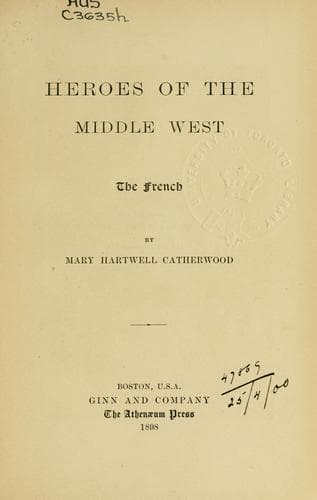
Heroes of the Middle West: The FrenchCatherwood, Mary Hartwell
History
Heroes of the Middle West: The French
Catherwood, Mary Hartwell
Mississippi River Valley -- Discovery and exploration; Mississippi River Valley -- History -- To 1803
"How can a man with a copper hand be of service in the wilderness?"
The first ranger shrugged. "That I know not. But having been maimed in
European wars and fitted with a copper hand, he was yet recommended to
Sieur de la Salle."
"But why hath an Italian the uniform of France?"
"He is a French officer, having been exiled with his father from his own
country."
The coureur de bois, who had reached the settlement later than his
companion, grunted.
"One would say thou wert of the Griffin crew thyself, with the latest
news from Quebec and Montreal."
"Not I," laughed the first one. "I have only been in the woods with
Greysolon du Lhut, who knows everything."
"Then he told thee the name of this Italian with the copper hand?"
"Assuredly. This Italian with the copper hand is Sieur Greysolon du
Lhut's cousin, and his name is Henri de Tonty."
"I will say this for Monsieur Henri de Tonty: a better made man never
stepped on the strand at St. Ignace."
[Illustration: Autograph of Tonty.]
Greysolon du Lhut was the captain of coureurs de bois in the northwest.
No other leader had such influence with the lawless and daring. When
these men were gathered in a settlement, spending what they had earned
in drinking and gaming, it was hard to restrain them within civilized
bounds. But when they took service to shoulder loads and march into the
wilderness, the strongest hand could not keep them from open rebellion
and desertion. There were few devoted and faithful voyageurs, such
as Pierre Porteret and Jacques had proved themselves in following
Marquette. The term of service was usually two years; but at the first
hardship some might slip away in the night, even at the risk of
perishing before they reached the settlements.
St. Ignace made a procession behind La Salle's party and followed them
into the chapel to hear mass--French traders, Ottawas, Hurons, coureurs
de bois, squaws, and children. When the priest turned from the altar, he
looked down on complexions ranging from the natural pallor of La Salle
to the black-red of the most weather-beaten native.
[Illustration: Totem of the Hurons.]
The Hurons then living at St. Ignace, whom Father Marquette had led
there from his earlier mission, afterwards wandered to Detroit and
Sandusky, the priests having decided to abandon St. Ignace and burn the
chapel. In our own day we hear of their descendants as settled in the
Indian Territory, the smallest but wealthiest band of all transplanted
Indians.
Public-domain text, read in full here on John Shaqi.
Reviews
Reviews
No reviews yet
Be the first to share your thoughts on this work.
Join the Discussion
Join the discussion
Sign in to leave a comment or review.
Sign InorCreate an account