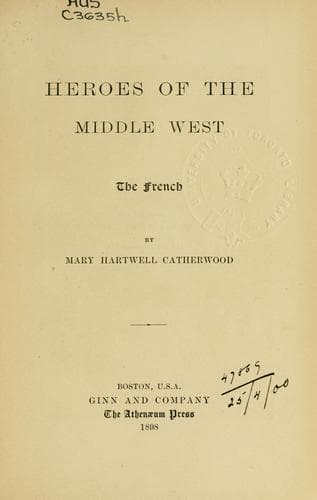
Heroes of the Middle West: The FrenchCatherwood, Mary Hartwell
History
Heroes of the Middle West: The French
Catherwood, Mary Hartwell
Mississippi River Valley -- Discovery and exploration; Mississippi River Valley -- History -- To 1803
For by this time, so long did it take to cover distances in the
wilderness, spring and summer were past, and the Illinois were dwelling
in their great town, nearly opposite the rock which La Salle desired to
have fortified. Tonty often gazed at it across the river, which flows
southwestward there, with a ripple that does not break into actual
rapids. The yellow sandstone height, rising like a square mountain out
of the shore, was tufted with ferns and trees. No man could ascend it
except at the southeast corner, and at that place a ladder or a rope was
needed by the unskillful. It had a flat, grassy top shut in by trees,
through which one could see the surrounding country as from a tower.
A ravine behind it was banked and floored with dazzling white sand, and
walled at the farther side by a timbered cliff rising to a prairie.
With a score of men Tonty could have held this natural fortress against
any attack. Buckets might be rigged from overhanging trees to draw up
water from the river. Provisions and ammunition only were needed for a
garrison. This is now called Starved Rock, and is nearly opposite the
town of Utica. Some distance up the river is a longer ridge, yet known
as Buffalo Rock, easy of ascent at one end, up which the savages are
said to have chased buffaloes; and precipitous at the other, down which
the frightened beasts plunged to death.
The tenth day of September a mellow autumn sun shone on maize fields
where squaws labored, on lazy old braves sprawled around buffalo robes,
gambling with cherry stones, and on peaceful lodges above which the blue
smoke faintly wavered. It was so warm the fires were nearly out. Young
warriors of the tribes were away on an expedition; but the populous
Indian town swarmed with its thousands.
Father Ribourde and Father Membre had that morning withdrawn a league up
the river to make what they called a retreat for prayer and meditation.
The other Frenchmen were divided between lodge and garden.
Near this living town was the town of the dead, a hamlet of scaffolds,
where, wrapped in skins, above the reach of wolves, Illinois Indians of
a past generation slept their winters and summers away. Crows flapped
across them and settled on the corn, causing much ado among the papooses
who were set to shout and rattle sticks for the protection of the crop.
Suddenly a man ran into camp, having just leaped from the canoe which
brought him across the river. When he had talked an instant old braves
bounded to their feet with furious cries, the tribes flocked out of
lodges, and women and children caught the panic and came screeching.
"What is the matter?" exclaimed Tonty, unable to understand their rapid
jargon. The Frenchmen drew together with the instinct of uniting in
peril, and, led by old men, the Indian mob turned on them.
"What is it?" cried Tonty.
"The Iroquois are coming! The Iroquois are coming to eat us up! These
Frenchmen have brought the Iroquois upon us!"
Public-domain text, read in full here on John Shaqi.
Reviews
Reviews
No reviews yet
Be the first to share your thoughts on this work.
Join the Discussion
Join the discussion
Sign in to leave a comment or review.
Sign InorCreate an account