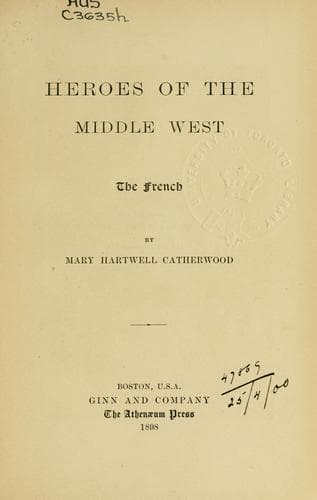
Heroes of the Middle West: The FrenchCatherwood, Mary Hartwell
History
Heroes of the Middle West: The French
Catherwood, Mary Hartwell
Mississippi River Valley -- Discovery and exploration; Mississippi River Valley -- History -- To 1803
The explorers took with them a party of five men. Their canoes, we are
told, were of birch bark and cedar splints, the ribs being shaped from
spruce roots. Covered with the pitch of yellow pine, and light enough
to be carried on the shoulders of four men across portages, these canoes
yet had toughness equal to any river voyage. They were provisioned with
smoked meat and Indian corn. Shoved clear of the beach, they shot out
on the blue water to the dip of paddles. Marquette waved his adieu.
His Indians, remembering the dangers of that southern country, scarcely
hoped to see him again. Marquette, though a young man, was of no such
sturdy build as Jolliet. Among descendants of the Ottawas you may still
hear the tradition that he had a "white face, and long hair the color
of the sun" flowing to the shoulders of his black robe.
The watching figures dwindled, as did the palisaded settlement. Hugging
the shore, the canoes entered Lake Michigan, or, as it was then called,
the Lake of the Illinois. All the islands behind seemed to meet and
intermingle and to cover themselves with blue haze as they went down
on the water. Priest and trader, their skins moist with the breath
of the lake, each in his own canoe, faced silently the unknown world
toward which they were venturing. The shaggy coast line bristled with
evergreens, and though rocky, it was low, unlike the white cliffs of
Michilimackinac.
Marquette had made a map from the descriptions of the Illinois Indians.
The canoes were moving westward on the course indicated by his map.
He was peculiarly gifted as a missionary, for already he spoke six
Indian languages, and readily adapted himself to any dialect. Marquette,
the records tell us, came of "an old and honorable family of Laon," in
northern France. Century after century the Marquettes bore high honors
in Laon, and their armorial bearings commemorated devotion to the
king in distress. In our own Revolutionary War it is said that three
Marquettes fought for us with La Fayette. No young man of his time had
a pleasanter or easier life offered him at home than Jacques Marquette.
But he chose to devote himself to missionary labor in the New World,
and had already helped to found three missions, enduring much hardship.
Indian half-breeds, at what is now called the "Soo," on St. Mary's
River, betwixt Lake Huron and Lake Superior, have a tradition that
Father Marquette and Father Dablon built their missionary station on
a tiny island of rocks, not more than two canoe lengths from shore, on
the American side. But men who have written books declare it was on the
bank below the rapids.
[Illustration: Autograph of Jolliet.]
Public-domain text, read in full here on John Shaqi.
Reviews
Reviews
No reviews yet
Be the first to share your thoughts on this work.
Join the Discussion
Join the discussion
Sign in to leave a comment or review.
Sign InorCreate an account