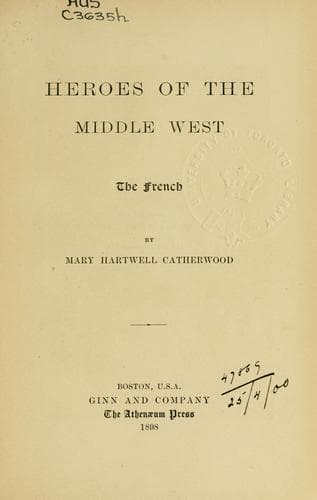
Heroes of the Middle West: The French — John Shaqi
Heroes of the Middle West: The FrenchCatherwood, Mary Hartwell
History
Heroes of the Middle West: The French
Catherwood, Mary Hartwell
Mississippi River Valley -- Discovery and exploration; Mississippi River Valley -- History -- To 1803
The next was oil to anoint him and the Recollets, so their joints would
move easily in traveling.
The next said that the sun was bright.
And the sixth and last pack ordered the French to get up and leave
the country.
When the speaker sat down, Tonty came to his feet and looked at the
beaver skins piled before them. Then he looked around the circle of hard
weather-beaten faces and restless eyes, and thanked the Iroquois for
their gift.
"But I would know," said Tonty, "how soon you yourselves intend to
leave the country and let the Illinois be in peace?"
There was a growl, and a number of the braves burst out with the
declaration that they intended to eat Illinois flesh first.
Tonty raised his foot and kicked the beaver skins from him. In that very
way they would have rejected a one-sided treaty themselves. Up they
sprang with drawn knives and drove him and Father Membre from the fort.
All night the French stood guard for fear of being surprised and
massacred in their lodge. At daybreak the chiefs ordered them to go
without waiting another hour, and gave them a leaky boat.
Tonty had protected the retreat of the Illinois as long as he could.
With the two Recollets, Boisrondet, young Renault, and L'Esperance, and
with little else, he set out up the river.
[Illustration: SITE OF FORT ST. LOUIS OF THE ILLINOIS.
From a Recent Photograph.]
IV.
THE UNDESPAIRING NORMAN.
"The northward current of the eastern shore of Lake Michigan and
the southward current of the western shore," says a writer exact in
knowledge, "naturally made the St. Joseph portage a return route to
Canada, and the Chicago portage an outbound one." But though La Salle
was a careful observer and must have known that what was then called the
Chekago River afforded a very short carrying to the Desplaines or upper
Illinois, he saw fit to use the St. Joseph both coming and going.
His march to Fort Frontenac he afterwards described in a letter to one
of the creditors interested in his discoveries.
"Though the thaws of approaching spring greatly increased the difficulty
of the way, interrupted as it was everywhere by marshes and rivers, to
say nothing of the length of the journey, which is about five hundred
leagues in a direct line, and the danger of meeting Indians of four or
five different nations, through whose country we were to pass, as well
as an Iroquois army which we knew was coming that way; though we must
suffer all the time from hunger; sleep on the open ground, and often
without food; watch by night and march by day, loaded with baggage, such
as blanket, clothing, kettle, hatchet, gun, powder, lead, and skins to
make moccasins; sometimes pushing through thickets, sometimes climbing
rocks covered with ice and snow; sometimes wading whole days through
marshes where the water was waist deep or even more,--all this did not
prevent me from going to Fort Frontenac to bring back the things we
needed and to learn myself what had become of my vessel."
Public-domain text, read in full here on John Shaqi.
Reviews
Reviews
No reviews yet
Be the first to share your thoughts on this work.
Join the Discussion
Join the discussion
Sign in to leave a comment or review.
Sign InorCreate an account