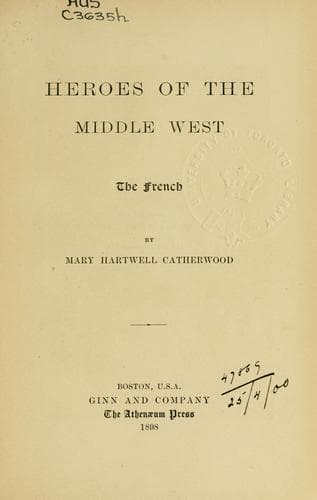
Heroes of the Middle West: The FrenchCatherwood, Mary Hartwell
History
Heroes of the Middle West: The French
Catherwood, Mary Hartwell
Mississippi River Valley -- Discovery and exploration; Mississippi River Valley -- History -- To 1803
When the two Miamis had helped to carry the goods and had set the French
on the tributary of the great river, they turned back to their own
country. Before the men entered the boats Marquette knelt down with
them on the bank and prayed for the success of the undertaking. It was
a lovely broad river on which they now embarked, with shining sands
showing through the clear water, making shallows like tumbling discs
of brilliant metal,--a river in which the canoes might sometimes run
aground, but one that deceived the eye pleasantly, with islands all vine
covered, so when a boat clove a way between two it was a guess how far
the Wisconsin spread away on each side to shores of a fertile land.
Oaks, walnuts, whitewood, and thorn trees crowded the banks or fell
apart, showing prairies rolling to wooded hills. Deer were surprised,
stretching their delicate necks down to drink at the margin. They looked
up with shy large eyes at such strange objects moving on their stream,
and shot off through the brush like red-brown arrows tipped with white.
The moose planted its forefeet and stared stolidly, its broad horns set
in defense.
"Sieur Jolliet," said the missionary, once when the canoes drew
together, "we have now left the waters which flow into the great lakes
and are discharged through the St. Lawrence past Quebec to the sea.
We follow those that lead us into strange lands."
"This river Miscousing on which we now are," returned Jolliet, "flows,
as we see by our compass, to the southwestward. We know it is a branch
of the great river. I am becoming convinced, Father, that the great
river cannot discharge itself toward the east, as some have supposed."
The explorers estimated the distance from the country of the Mascoutins
to the portage to be three leagues, and from the portage to the mouth
of the Miscousing forty leagues. This distance they covered in a week.
Drawing their canoes to the shore at night, they pitched camp, varying
the monotony of their stores with fish and game. Perhaps they had
learned that wild grapes then budding were not really fit to eat until
touched by frost. Pierre Porteret said in Marquette's hearing, "the
Indians could make good wine of grapes and plums if they desired."
Public-domain text, read in full here on John Shaqi.
Reviews
Reviews
No reviews yet
Be the first to share your thoughts on this work.
Join the Discussion
Join the discussion
Sign in to leave a comment or review.
Sign InorCreate an account