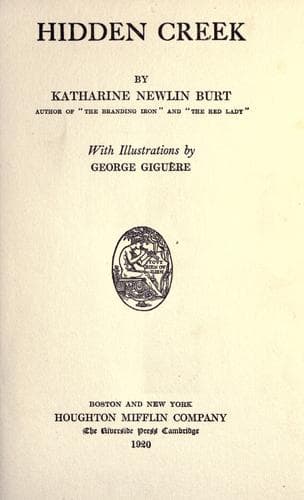
Frontier and pioneer life -- West (U.S.) -- Fiction; Orphans -- Fiction; Young women -- Fiction
No sight more familiar to the corner of Main and Resident Streets than
that of Sylvester Hudson's Ford car sliding up to the curb in front of
his hotel at two o'clock in a summer afternoon. He would slip out from
under his steering-wheel, his linen duster flapping about his long legs,
and he would stalk through the rocking, meditative observers on the
piazza and through the lobby past Dickie's frozen stare, upstairs to the
door of Miss Arundel's "suite." There he was bidden to come in. A few
minutes later they would come down together, Sheila, too, passing Dickie
wordlessly, and they would hum away from Millings leaving a veil of
golden dust to smother the comments in their wake. There were days when
Sheila's pony, a gift from Jim Greely, was led up earlier than the hour
of Hudson's arrival, on which days Sheila, in a short skirt and a boy's
shirt and a small felt Stetson, would ride away alone toward the mountain
of her dreams. Sometimes Jim rode with her. It was not always possible to
forbid him.
The day after Cosme Hilliard's spectacular passage was one of Hudson's
days. The pony did not appear, but Sylvester did and came down with his
prize. The lobby was crowded. Sheila threaded her way amongst the medley
of tourists, paused and deliberately drew near to the desk. At sight of
her Dickie's whiteness dyed itself scarlet. He rose and with an apparent
effort lifted his eyes to her look.
They did not smile at each other. Sheila spoke sharply, each word a
little soft lash.
"I want to speak to you. Will you come to my sitting-room when I
get back?"
"Yes'm," said Dickie. It was the tone of an unwincing pride. Under the
desk, hidden from sight, his hand was a white-knuckled fist.
Sheila passed on, trailed by Hudson, who was smiling not agreeably to
himself. Over the smile he gave his son a cruel look. It was as though an
enemy had said, "Hurts you, doesn't it?" Dickie returned the look with
level eyes.
The rockers on the piazza stopped rocking, stopped talking, stopped
breathing, it would seem, to watch Sylvester help Sheila into his car;
not that he helped her greatly--she had an appearance of melting
through his hands and getting into her place beside his by a sort of
sleight of body. He made a series of angular movements, smiled at her,
and started the car.
"Well, little girl," said he, "where to this afternoon?"
When Sheila rode her pony she always rode toward The Hill. But in that
direction she had never allowed Sylvester to take her. She looked vaguely
through the wind-shield now and said, "Anywhere--that cañon, the one we
came home by last week. It was so queer."
"It'll be dern dusty, I'm afraid."
"I don't care." Sheila wrapped her gray veil over her small hat which
fitted close about her face. "I'm getting used to the dust. Does it ever
rain around Millings? And does it ever stop blowing?"
"We don't like Millings to-day, do we?"
Public-domain text, read in full here on John Shaqi.
Reviews
Reviews
No reviews yet
Be the first to share your thoughts on this work.
Join the Discussion
Join the discussion
Sign in to leave a comment or review.
Sign InorCreate an account