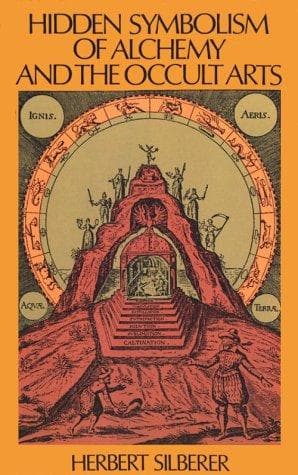
Hidden Symbolism of Alchemy and the Occult ArtsSilberer, Herbert
Religion
Hidden Symbolism of Alchemy and the Occult Arts
Silberer, Herbert
Alchemy; Society of Rosicrucians; Symbolism (Psychology)
Ruland (Lex., p. 26) defines alchemy very finely: [In reference to Tab.
Smar., 9] “Alchemy is the separation of the impure from a purer
substance.” This is quite as true of the chemical as of the spiritual
alchemy.
Why the hermetic philosophers write not literally but in figures may be
accounted for in several ways. We should first of all remember that
because of their free doctrine, which was indeed not at variance with true
Christianity but with the narrow-minded church, they had to fear the
persecution of the latter, and that for this reason they veiled their
teachings. Hitchcock notices also a further point. The alchemists often
declare that the knowledge of their secret is dangerous (for the
generality of people). It appears that they did not deem that the time was
ripe for a religion that was based more on ideal requirements, on moral
freedom, than on fear of hell fire, expectation of rewards and on
externally visible marks and pledges. Besides we shall see later that a
really clear language is in the nature of things neither possible nor from
an educational point of view to be recommended.
Still the mystical purpose of the authors of those times when the
precautionary measures were not necessary appears clearer under the
alchemistic clothing, although no general rule applying to it can be set
forth. Other reasons, e.g., intellectual and conventional ones, influenced
them to retain the symbolism.
Very clearly mystical are the writings of a number of hermetic artists,
who are permeated by the spiritual doctrine of Jacob Boehme. This
theosophist makes such full use of the alchemistic symbolism, that we find
it wherever we open his writings. I will not even begin to quote him, but
will only call the reader’s attention to his brief and beautifully
thoughtful description of the mystical process of moral perfection, which
stands as “Processus” at the end of the 5th chapter of his book, “De
Signatura Rerum.” (Ausg., Gichtel Col., 2218 f.)
An anonymous author who has absorbed much of the “Philosophicus
Teutonicus,” wrote the book, “Amor Proximi,” much valued by the amateurs
of the high art. It does not require great penetration to recognize this
pious manual, clothed throughout in alchemistic garments, as a mystical
work. The same is true of the formerly famous “Wasserstein der Weisen”
(1st ed. appeared 1619), and similar books. Here are some illustrative
pages from “Amor Proximi”:
“This [Symbol: water] [[Symbol: water] of life] is now the creature not
foreign or external but most intimate in every one, although hidden....
See Christ is not outside of us, but intimately within us, although
hidden.” (P. 32.)
“Whoever is to work out a thing practically must first have a fundamental
knowledge of a thing; in order that man shall macrocosmically and
magically work out the image of God, all God’s kingdom, in himself; he
must have its right knowledge in himself....” (P. 29.)
Public-domain text, read in full here on John Shaqi.
Reviews
Reviews
No reviews yet
Be the first to share your thoughts on this work.
Elsewhere in the archive
Join the Discussion
Join the discussion
Sign in to leave a comment or review.
Sign InorCreate an account