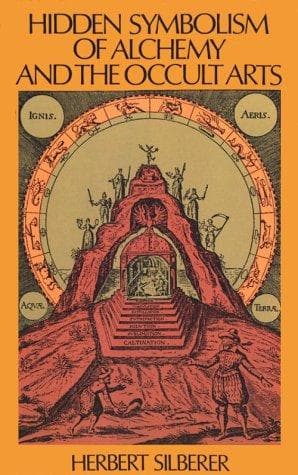
Hidden Symbolism of Alchemy and the Occult ArtsSilberer, Herbert
Religion
Hidden Symbolism of Alchemy and the Occult Arts
Silberer, Herbert
Alchemy; Society of Rosicrucians; Symbolism (Psychology)
Some of the writers tell us to put “one of the bodies into the alembic,”
that is to say, take the soul into the thought or study and apply the fire
(of intellect) to it, until it “goes over” into spirit. Then, “putting
this by for use,” put in “the other body,” which is to be subjected to a
similar trial until it “goes over” also; after which the two may be
united, being found essentially or substantially the same.
The two methods of which Irenaeus speaks are also called in alchemy (with
reference to chemical procedures) the wet and the dry ways. The wet way is
that which leads to unity through mental elaboration. The philosophy of
the Indian didactic poetry Bhagavad-Gita also knows the two ways and calls
them Samkhya and Yoga.
“Thinking (Samkhya) and devotion (Yoga) separate only fools, but
not the wise.
Whoever consecrates himself only to the One, gets both fruits.
Through thinking and through devotion the same point is reached,
Thinking and devotion are only One, who knows that, knows
rightly.”
Bh-G. V. 4ff.
“Samkhya” and “Yoga” have later been elaborated into whole philosophical
systems. Originally, however, they are merely “different methods of
arriving at the same end, namely the attainment of the Atman [all spirit]
which on the one hand is spread out as the whole infinite universe and on
the other is to be completely and wholly found in the inner life. In the
first sense Atman can be gained by meditation on the multiplex phenomena
of the universe and their essential unity, and this meditation is called
Samkhya [from sam + khya, reflection, meditation]; on the other hand,
Atman is attainable by retirement from the outer world and concentration
upon one’s own inner world and this concentration is called Yoga.”
(Deussen, Allg. Gesch. d. Phil., I, 3, p. 15.)
For the practice of alchemy a moral behavior is required, which is hardly
necessary as a precondition of merely chemical work. The disciple of the
art is to free his character, according to the directions of the masters
from all bad habits, especially to abjure pride, is diligently to devote
himself to prayer, perform works of love, etc.; no one is to direct his
senses to this study if he has not previously purified his heart,
renounced the love of worldly things, and surrendered himself completely
to God. (Höhler, Herm. Phil., pp. 62 ff.)
The sloppers, who strive to make gold in a chemical laboratory often waste
in it their entire estate. The adepts, however, assure us that even a poor
man can obtain the stone; many, indeed, say the poor have a better materia
than the rich. Rom. II, 11: “For there is no respect of persons with God.”
Matth. XIX, 24: “It is easier for a camel to go through the eye of a
needle than for a rich man to enter into the kingdom of God.” The
alchemist Khunrath says somewhere, the cost of making gold amounts to
thirty dollars; we understand this when we remember that Jesus was sold
for thirty pence.
Public-domain text, read in full here on John Shaqi.
Reviews
Reviews
No reviews yet
Be the first to share your thoughts on this work.
Elsewhere in the archive
Join the Discussion
Join the discussion
Sign in to leave a comment or review.
Sign InorCreate an account