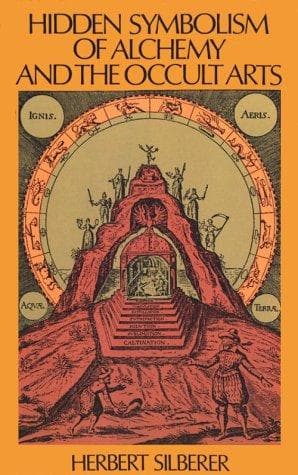
Hidden Symbolism of Alchemy and the Occult ArtsSilberer, Herbert
Religion
Hidden Symbolism of Alchemy and the Occult Arts
Silberer, Herbert
Alchemy; Society of Rosicrucians; Symbolism (Psychology)
The previous chapter has shown that there was a higher alchemy—it was
furthermore regarded as the true alchemy—which has the same relation to
practical chemistry that freemasonry has to practical masonry. A prominent
chemist who had entered into the history of chemistry and that of
freemasonry once wrote to me: “Whoever desires to make a chemical
preparation according to a hermetic recipe seems to me like a person who
undertakes to build a house according to the ritual of Freemasonry.”
The similarity is not a chance one. Both external and internal relations
between alchemy and freemasonry are worthy of notice. The connection is
partly through rosicrucianism. Since the Parable, which shall still be the
center of our study, belongs to rosicrucian literature (and indeed is
probably a later development of it), it is fitting here to examine who and
what the Rosicrucians really were. We cannot, of course, go into a
thorough discussion of this unusually complex subject. We shall mention
only what is necessary to our purpose. I shall not, however, be partial,
but treat of both the parties which are diametrically opposed in their
views of the problems of rosicrucian history. It will be shown that this
disagreement fortunately has but small influence upon our problem and that
therefore we are relieved of the difficult task of reaching a conclusion
and of bringing historical proof for a decision which experienced
specialists—of whom I am not one—have so signally failed to reach.
Rosicrucians are divided into those of three periods, the old, who are
connected by the two chief writings, “Fama” and “Confessio,” that appeared
at the beginning of the 17th century; the middle, which apparently
represents a degeneration of the original idealistic league, and finally,
the gold crossers and rose crossers, who for a time during the 18th
century developed greater power. The last Rosicrucians broke into
freemasonry for a while (in the second half of the eighteenth century) in
a manner almost catastrophic for continental masonry, yet I observe in
anticipation that this kind of rosicrucian expansion is not immediately
concerned with the question as to the original relation of freemasonry and
rosicrucianism. We must know how to distinguish the excrescence from the
real idea. Rosicrucianism died out at the beginning of the 19th century.
The rosicrucian degrees that still exist in many systems of freemasonry
(as Knight of the Red Cross, etc.) are historical relics. Those who now
parade as rosicrucians are imposters or imposed on, or societies that have
used rosicrucian names as a label.
Public-domain text, read in full here on John Shaqi.
Reviews
Reviews
No reviews yet
Be the first to share your thoughts on this work.
Elsewhere in the archive
Join the Discussion
Join the discussion
Sign in to leave a comment or review.
Sign InorCreate an account