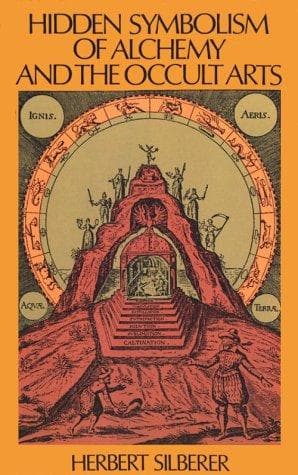
Hidden Symbolism of Alchemy and the Occult ArtsSilberer, Herbert
Religion
Hidden Symbolism of Alchemy and the Occult Arts
Silberer, Herbert
Alchemy; Society of Rosicrucians; Symbolism (Psychology)
Many serious scholars doubt that the old Rosicrucians ever existed as an
organized fraternity. I refer to the article Rosenkreuz in the “Handbuch
der Freimaurerei” (Lenning), where this skeptical view is dominant. Other
authors, on the contrary, believe in the existence of the old order and
think that the freemasons who appeared in their present form in 1717 are
the rosicrucians persisting, but with changed name. Joh. Gottl. Buhle, a
contemporary of Nicolai, had already assumed that the rosicrucian Michael
Maier introduced rosicrucianism into England, and that freemasonry began
then especially with the coöperation of the Englishman Robert Fludd
(1574-1637). Ferdinand Katsch warmly defended the actual existence of the
old rosicrucian fraternity with arguments, some of which are disputed. He
names with certainty a number of people as “true rosicrucians,” among them
Julianus de Campis, Michael Maier, Robert Fludd, Frisius or Frizius,
Comenius (Katch, p. 33). Rosicrucianism turned into freemasonry for
practical reasons. As the most outstanding imposters represented
themselves as rosicrucians this name was not conserved. The wrong was
prevented, in that the true rosicrucians withdrew as such and assumed a
different dress.
Generally we imagine a different origin of freemasonry. We are accustomed
to look for its beginnings in practical masonry, whose lodges can be
traced back to the fourteenth century. The old unions of house builders
were joined by persons who were not actual workers but lay members,
through whom spiritual power was added to the lodges. At the beginning of
the eighteenth century the old working masonry was transformed into the
spiritual symbolical freemasonry, but with a continuance of its forms. At
that time in London the building lodges had diminished to four. These were
united on June 24 (St. John’s Day), 1717, and chose Anton Sayer for their
grand master. That is the origin of Freemasonry as it exists to-day.
Public-domain text, read in full here on John Shaqi.
Reviews
Reviews
No reviews yet
Be the first to share your thoughts on this work.
Elsewhere in the archive
Join the Discussion
Join the discussion
Sign in to leave a comment or review.
Sign InorCreate an account