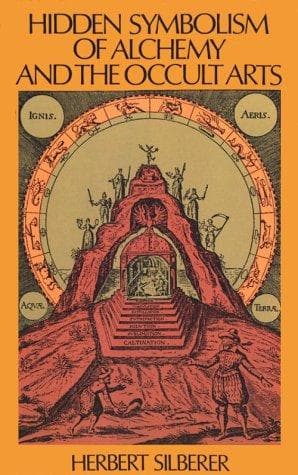
Hidden Symbolism of Alchemy and the Occult ArtsSilberer, Herbert
Religion
Hidden Symbolism of Alchemy and the Occult Arts
Silberer, Herbert
Alchemy; Society of Rosicrucians; Symbolism (Psychology)
This derivation is and will be considered unsatisfactory by many, however
much it may satisfy the merely documentary claims. The attempt to make it
better required an inventive phantasy and this was not always fortunate in
its attempts. The rosicrucian theory cannot be dismissed off hand,
especially if we conceive it in a somewhat broader sense. In agreement
with Katsch, Höhler (Herm. Phil., p. 6) recalls how generally people were
occupied in the 16th and 17th centuries in the whole of western Europe
with cabala, theosophy, magic (physics), astrology and alchemy, and indeed
this held true of higher and lower social strata, scholars and laymen,
ecclesiastic and secular. “The entire learned theology turned on cabala.
Medicine was based on theosophy and alchemy and the latter was supposed to
be derived from theosophy and astrology.” Höhler, in one respect, goes
further than Katsch and conjectures: “Freemasonry had its roots in the
chemical societies of the 16th and 17th centuries, in which all those
things were fostered that constituted the science of that day.” This
theory is incomparably more open to discussion than if one attempts to
confine the origin to the insecure base of rosicrucianism. We shall learn
to appreciate more fully the significance of the chemical societies.
In connection with the question, important for us, as to the position of
the alchemy of the rosicrucians (whether they lived only in books or as an
actual brotherhood), it is worth while to glance at the literature.
Joachin Frizius, whom some think identical with Fludd, writes in the
“Summum Bonum, quod est verum Magiae, Cabalae, Alchymiae, verae Fratrum
Roseae Crucis verorum subjectum” (first published in Frankfort, 1629):
“Aben (אבן) means a stone. In this one cabbalistic stone we have the
Father, Son and Holy Ghost ... for in Hebrew Ab (אב) means Father and Ben
(בן) Son. But where the Father and Son are present there the Holy Ghost
must be also.... Let us now examine this Stone as the foundation of the
macrocosm.... Therefore the patriarch Jacob spake, ‘How dreadful is this
place. This is none other but the house of God,’ and rose up and took the
stone that he had put for his pillow and poured oil upon the top of it,
and said, ‘This stone that I have set for a pillar shall be God’s house,
etc.’ If therefore a God’s house, then God is in that place or else his
earthly substance. Here it was that the patriarch, as he slept on this
stone, conserved something divine and miraculous, through the power of
that spirit-filled stone which in its corporeality is similar to the
relation of the body to the soul. But the spiritual stone was Christ; but
Christ is the eternal wisdom, in which as the scripture says are many
mansions, which are undoubtedly distinguished on account of the different
grades of grace and blessedness. For blessedness follows wisdom or
knowledge, the higher and more we know the farther we go towards the
Godhead.” (Summ. Bon., pp. 17 ff.)
Public-domain text, read in full here on John Shaqi.
Reviews
Reviews
No reviews yet
Be the first to share your thoughts on this work.
Elsewhere in the archive
Join the Discussion
Join the discussion
Sign in to leave a comment or review.
Sign InorCreate an account