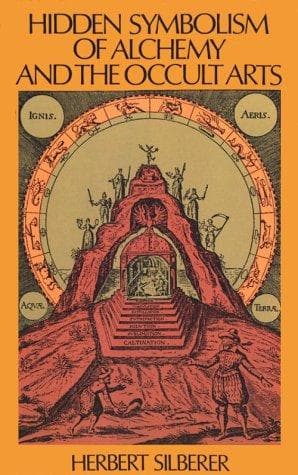
Hidden Symbolism of Alchemy and the Occult ArtsSilberer, Herbert
Religion
Hidden Symbolism of Alchemy and the Occult Arts
Silberer, Herbert
Alchemy; Society of Rosicrucians; Symbolism (Psychology)
Many of these symbols, it should be noted in passing, are borrowed from
those tokens and implements of the building corporations, which were
necessary to the completion of their buildings (Keller, l. c., p. 4). An
important part was played even in the early Christian symbolism by the
sacred numbers and the figures corresponding to them, a group of
educational symbols which we find likewise in the pythagorean and platonic
schools. It is known that the symbolical language of the subterranean rock
temples, some of which were used by the earliest Christians for their
religious worship, are closely connected with the pythagorean and platonic
doctrines. From the year 325 A. D. on, every departure from the beliefs of
the state church was considered a state offense. So those Christians who
retained connection with the ancient philosophic schools were persecuted.
In the religious symbol language of the church, the sacred numbers
naturally began to disappear from that time. In the writings of Augustine
begins the war on the symbolic language, whose use he declared a
characteristic of the gnostics. In spite of the suppression the doctrines
of the sacred numbers continued through all the centuries in religious
use, in quiet but strong currents which flowed beside the state church.
The sect names, which were invented by polemic theology for the purpose of
characterizing methods that were regarded as imitations of the gnostics,
are of the most varied kinds; it may be enough to remember that in all
those spiritual currents, that like the old German mysticism, the earlier
humanism, the so-called natural philosophy, etc., show a strong influence
of platonic thinking, the doctrines of the sacred numbers recur, in a more
or less disguised form, but yet clearly recognizable. (Keller, Heil.
Zahl., p. 2.)
As the old number symbolism constitutes a part of the hieroglyphics of
alchemy, I shall pause a moment to consider them. The use of mathematical
and geometrical symbols proceeds from the use of the simplest forms,
points and lines, but in all cases where the object is not a
representation in the flat but in space, both the points and lines are
replaced by plastic forms, i.e., forms of cylinders, spheres, bars, rings,
cubes, etc. From this point it was but a short step to the use of trees,
leaves, flowers, implements, and other things that showed similarities in
form. Pillars are specially noticeable for the symbolism of the ceremonial
chamber. In all cases where points and lines occur in images and drawings,
pillars are found in the plastic representation of thoughts and symbols.
They form the chief element of the organization of cults in academies and
museums, and justify the names of colonnade, stoa, portico, and loggia,
which occur everywhere; besides the special designation like Οἰκυς
αἰονὶος, etc.
Public-domain text, read in full here on John Shaqi.
Reviews
Reviews
No reviews yet
Be the first to share your thoughts on this work.
Elsewhere in the archive
Join the Discussion
Join the discussion
Sign in to leave a comment or review.
Sign InorCreate an account