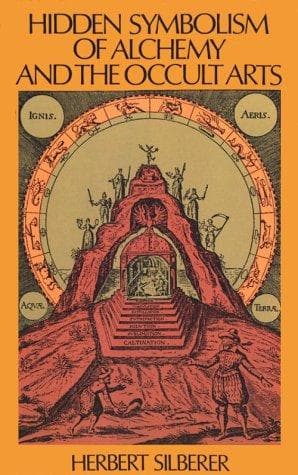
Hidden Symbolism of Alchemy and the Occult ArtsSilberer, Herbert
Religion
Hidden Symbolism of Alchemy and the Occult Arts
Silberer, Herbert
Alchemy; Society of Rosicrucians; Symbolism (Psychology)
In the symbols of the alchemists, the rosicrucians, the Lodges, etc., “we
meet a language that has found acceptance among all occidental peoples in
analogous form, not indeed a letter or word language, but a language
nevertheless, a token or a symbol language of developed form, which is
evident even in the rock temples of the so-called catacombs, once called
latomies and loggie. The single images and symbols have something to say
only to the person who understands this language. To the man who does not
understand it, they say nothing and are not expected to say anything.”
In reference to the symbol and image language, which was comprehensible
only to the initiated, we think naturally of the ancient mysteries. The
religious societies of the oldest Christians, in the centuries when
Christianity belonged in the Roman Empire to the forbidden cults, found a
possibility of existence before the law in the form of licensed societies,
i.e., as guilds, burial unions, and corporations of all sorts. The
primitive Christians were not the only forbidden sects that sought and
found this recourse. Under the disguise of schools, trade unions, literary
societies, and academies, there existed in the jurisdiction of the Roman
Empire, and later inside of the world church, organizations that before
the law were secular societies, but in the minds of the initiated were
associations of a religious character. Within these associations there
appeared very early a well developed system of symbols, which were adopted
for the purpose of actually maintaining, through the concealment
necessitated by circumstances, their unions and their implements and
customs—symbols that they chose as cloaks and that in the circle of the
initiated were explained and interpreted according to the teachings of
their cult.
Valuable monuments of this symbolism are preserved in the vast rock
temples that are found in Egypt, Syria, Asia Minor, Sicily, and the
Apennine peninsula, in Greece, France, and on the Rhine, and these vaults,
which in part also served the early Christians as places of worship, show
in their images and records and in their architectural form so close a
resemblance that they must be acknowledged as the characteristic of a
great religious cult extending over many lands, which has had consistent
traditions for the use of such symbols and for the production of these
structures.
Public-domain text, read in full here on John Shaqi.
Reviews
Reviews
No reviews yet
Be the first to share your thoughts on this work.
Elsewhere in the archive
Join the Discussion
Join the discussion
Sign in to leave a comment or review.
Sign InorCreate an account