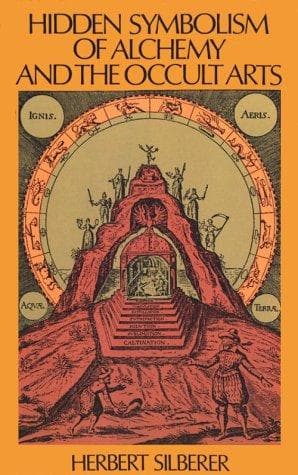
Hidden Symbolism of Alchemy and the Occult ArtsSilberer, Herbert
Religion
Hidden Symbolism of Alchemy and the Occult Arts
Silberer, Herbert
Alchemy; Society of Rosicrucians; Symbolism (Psychology)
water, however, mean also the famous two opposites, that are symbolized
quite as well by warm and cold, red and white, soul and body, sun and
moon, man and woman.] With regard to the six points, in alchemy [Symbol:
Star of David] is also called chaos in contrast to [Symbol: Star of
David], which denotes cosmos, just as alum [Symbol: circle] on account of
its lack of a center (God, belief, union), is incomplete beside [Symbol:
sol]. In the catacombs the triangle is found also in multiple [five fold]
combination, [Symbol: Star of David].
Four lines, somewhat in the form of a rectangle, define the limited space
of the terrestrial world with the accessory meaning of the holy precinct,
house, temple. In masonry, [Symbol: square] is well known as the lodge.
The rectangle is related to the cube. I mention therefore in this place
the cubic stone, the mighty masonic symbol, whose equivalent in alchemy
will be discussed.
By a commonly used change of significance the number 5 is symbolized by
5-leaved plants (rose, lily, vine). “The flowers, however, and the garden
in which they grow, early served as symbols of the Fields of the Blessed
or the ‘better country’ in which dwell the souls passing through death to
life; in antithesis to the terrestrial house of God, the temple built with
hands, which was represented by the rectangle [Symbol: rectangle], the
holy number 5 denoted the celestial abodes of the souls that had attained
perfection, and therefore represented both the House of Eternity or the
City of God and the Heavenly Jerusalem. The holy pentagram in the form of
the rose, not only in the ancient but in the early Christian world,
decorated the graves of the dead, that in their turn symbolized the
gardens of the blessed. And the significance that the academies and loggia
attributed to the pentagram placed in the rose is explained by the fact
that their religious festival was closely connected with this emblem.
Already in the ancient world at the festival of St. John, the rose feast
or rhodismus or Rosalia was celebrated, at which the participants adorned
themselves with roses and held religious feasts.” (Keller, 1. c., p. 21.)
As already mentioned, the cross, i.e., the Greek cross with its four equal
arms, expresses the number five. It is interesting that already in the
ancient number symbolism, rose and cross appear united, a fact which I
mention here in view of the later connection of these two objects.
Public-domain text, read in full here on John Shaqi.
Reviews
Reviews
No reviews yet
Be the first to share your thoughts on this work.
Elsewhere in the archive
Join the Discussion
Join the discussion
Sign in to leave a comment or review.
Sign InorCreate an account