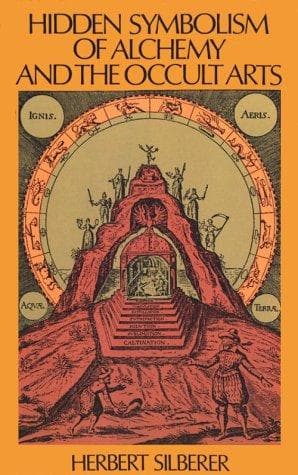
Hidden Symbolism of Alchemy and the Occult ArtsSilberer, Herbert
Religion
Hidden Symbolism of Alchemy and the Occult Arts
Silberer, Herbert
Alchemy; Society of Rosicrucians; Symbolism (Psychology)
The semicircle or moon is an emblem of borrowed light. Besides the circles
or spheres, the symbols of eons (divine beings, powers) that are enthroned
in the ether as eternal beings, the human soul—the psyche or anima, which
does not coincide with reason or the purified soul—appears as a broken
circle. As the sun and its symbol, the ragged circle, symbolize the
eternal light, the half circle is, as it were, the symbol of that spark of
light that slumbers in the soul of man, or, as the alchemists often say,
the hidden fire that is to be awakened by the process. If we reflect that
in this symbolism the cross expresses a penetration, the alchemic symbol
[Symbol: mercury] is explained. It is now quite interesting that the like
connection appears in the subterranean places of worship in this form
[Symbol: female with concave arc underneath it], (l. c., p. 27). Keller
calls it a symbol of the all and the soul of man.
The number 7 (seven planets, etc.) also is of some importance in the old
latomies. It is noteworthy besides that sun and moon usually appear as
human forms; the sun wears on its head a crown or garland or beaming star,
while the moon image is wont to carry the symbol [Symbol: Silver].
Alchemy, too, likes to represent [Symbol: Gold] and [Symbol: Silver] as
human, and indeed frequently as crowned figures, sometimes as a royal
bridal couple.
The ancient lore of the sacred numbers breathes a spirit that may be
embodied in the following words: The soul of man, which through
resignation or meekness, as they used to say then, is impelled onward to
purity and union with the Eternal, has in itself a higher life, which
cannot be annihilated by death. The doctrine of the infinite value of the
soul ... and of God’s entering into the pure soul of man forms the central
point of the thought of religious fellowship. Neither for sacrifice, which
the state religions practice, nor for the beliefs in demons, by which the
masses are controlled, nor for the idea of priesthood as means of
salvation, was there a place in this system, and not a trace of such a
belief is demonstrable in this religion of wisdom and virtue. (l. c., p.
33.)
Public-domain text, read in full here on John Shaqi.
Reviews
Reviews
No reviews yet
Be the first to share your thoughts on this work.
Elsewhere in the archive
Join the Discussion
Join the discussion
Sign in to leave a comment or review.
Sign InorCreate an account