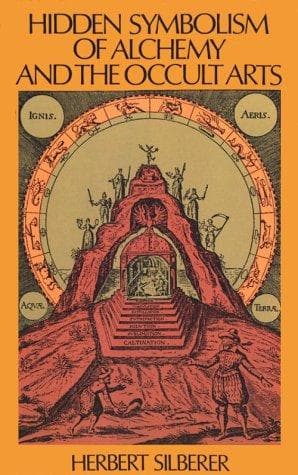
Hidden Symbolism of Alchemy and the Occult ArtsSilberer, Herbert
Religion
Hidden Symbolism of Alchemy and the Occult Arts
Silberer, Herbert
Alchemy; Society of Rosicrucians; Symbolism (Psychology)
The attempt mentioned, to find a common name, did not permanently succeed.
The visionaries and “heretics” decried as “Rosicrucians” and “alchymists”
were considered as enemies and persecuted. It is irrelevant whether there
was an organized fraternity of rosicrucians; it was enough to be known as
a rosicrucian. (Keller, Z. Gesch. d. B., p. 21.) The great organization
did not take place until a great European power spread over it its
protecting hand, i.e., in 1717, when in England the new English system of
“Grand Lodges of Free and Accepted Masons” arose. (Keller, D. Soc. d.
Hum., p. 18.) We see that Keller arrives by another and surer way than
Katsch at the same result, and shows the continuity of the alchemists or
rosicrucians and the later freemasons, if not in exactly the same way that
Katsch has outlined it. In particular Keller gets along without the
unproved statement that there were organized rosicrucians (outside of the
later gold- and rose-crosses). He shows what is much more important,
namely that there were societies that might have borne the name of
rosicrucians (or any similar name).
[Occult image.]
Figure 1.
Several interesting peculiarities should not be omitted, as for instance,
that Leibniz, about 1667, was secretary of an alchemist’s society (of
so-called rosicrucians) in Nuremberg. Leibniz describes alchemy as an
“introduction to mystic theology” and identifies the concepts of “Arcana
Naturae” and “Chymica.” (M. H. der C. G., 1903, p. 149; 1909, p. 169 ff.)
In the laws of the grand lodge “Indissolubilis” (17th and 18th centuries)
there are found as doctrinal symbols of the three grades, the alchemistic
symbols of salt (rectification, clarification), of quicksilver
(illumination), and of sulphur (unification, tincture), used in a way that
corresponds to the stages of realization of the “Great Work.” The M. H. d.
C. G., 1909, p. 173 ff. remarks that we should probably regard it only as
an accident, if there are not found, in the famous hermetic chemical
writings, similar signs with additions as would for experts, exclude all
doubt as to their purport. In 1660 appeared at Paris an edition of a
writing very celebrated among the followers of the art, “Twelve Keys of
Philosophy,” which was ostensibly written by one Brother Basilius
Valentinus. In this edition we see at the beginning a remarkable plate,
whose relation to masonic symbolism is unmistakable (Figure 1). In
addition to the lowest symbol of salt (represented as cubic stone) there
is a significant reference to the earth and the earthly. [I should note
that besides [Symbol: circle with diameter line] alchemy used [Symbol:
square] for salt, in which there is a special reference to the earthly
nature of salt. In Plato the smallest particles of the earth are cubical.
Salt and earth alternate in the terminology, just as mercury [Symbol:
female] and air [Symbol: air] or water [Symbol: water] do; as sulphur
Public-domain text, read in full here on John Shaqi.
Reviews
Reviews
No reviews yet
Be the first to share your thoughts on this work.
Elsewhere in the archive
Join the Discussion
Join the discussion
Sign in to leave a comment or review.
Sign InorCreate an account