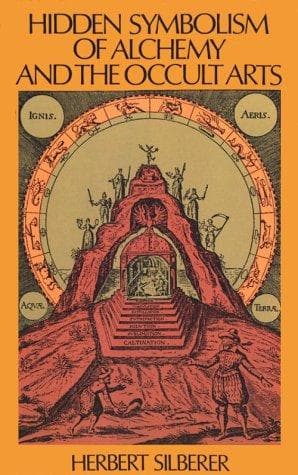
Hidden Symbolism of Alchemy and the Occult ArtsSilberer, Herbert
Religion
Hidden Symbolism of Alchemy and the Occult Arts
Silberer, Herbert
Alchemy; Society of Rosicrucians; Symbolism (Psychology)
After what has been said it is clear that the Parable contains instruction
in the sense of the higher alchemy. Whoever has attentively read this 4th
chapter will certainly be in a position to understand the parable, in
large part, in a hermetic sense. I do not wish to develop this
interpretation now, for to a certain extent it develops itself without
further effort, and what goes beyond that can be treated only in the
second part of this volume. I shall limit myself now to a few suggestions.
In regard to the external setting of the parable as a piece of rosicrucian
literature, we must remember that it was published in 1788, the time of
the later gold- and rose-cross societies, and in a book whose theosophic
and religious character is seen in all the figures contained in it as well
as in the greater part of the text. It is continually reiterated that gold
is not common gold but our gold, that the stone is a spiritual stone
(Jesus Christ), etc. The creation of the world, the religious duty of
mankind, the mystic path to the experiencing of divinity—all is
represented in detailed pictures with predominantly chemical symbolism.
This higher conception of alchemy, that corresponds throughout to the
ideal of the so-called old or true rosicrucian, does not prevent the
editor from believing in the possibility of miraculous gifts which are to
be gained through the hermetic art. Many parts of the book make us suspect
a certain naïveté that may go several degrees beyond the simplicity
required for religious development.
As for the origin of the parable there are two possibilities. Either the
editor is himself the author and as such retires into the background,
while he acts as collector of old rosicrucian manuscripts, that he now in
publishing, discloses to amateurs in the art, or the editor is merely
editor. In either case the obligation remains to interpret the parable
hermetically. The educational purpose of the editor is established. If he
is himself the author, he himself has clothed his teachings in the images
of the parable. If, on the contrary, the author is some one else (either a
contemporary and so [Symbol: sun] R. C. [Symbol: cross], or an old
hermetic philosopher, Fr. R. C.), the editor has found in the piece edited
by him a subject suitable to his purpose, a material that voices his
doctrines. We can evidently also rest satisfied, in order to evade the
question of authorship, that the writing itself gets its own character
from the hermetic interpretations, and shows in detail its correspondingly
theosophic material. Nevertheless I desire to show the directing hand of
the collector and editor.
Public-domain text, read in full here on John Shaqi.
Reviews
Reviews
No reviews yet
Be the first to share your thoughts on this work.
Elsewhere in the archive
Join the Discussion
Join the discussion
Sign in to leave a comment or review.
Sign InorCreate an account