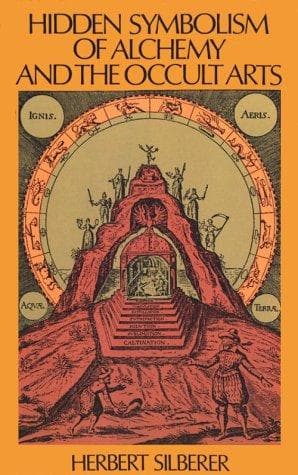
Hidden Symbolism of Alchemy and the Occult ArtsSilberer, Herbert
Religion
Hidden Symbolism of Alchemy and the Occult Arts
Silberer, Herbert
Alchemy; Society of Rosicrucians; Symbolism (Psychology)
Several controlling elements pointing toward a hermetic theosophic
interpretation, which the reader probably looks for in the parable, may be
shown if I mention the ethical purposes that here and there emerge in our
psychoanalytic interpretation of the parable. I might remind the reader
that the wanderer is a killer of dragons like St. George; the holy Mary is
represented standing over a dragon; also under the Buddha enthroned upon a
lotus flower, there curls not infrequently a vanquished dragon; etc. I
might mention the religious symbolism of the narrow path that leads to the
true life. Many occurrences in the parable are to be conceived as trials,
and we can see the wanderer overcome the elemental world (Nature triumphs
over Nature), wherein he is proved by all four elements and comes off
victorious from all tests. The fight with the lion in the den can be
regarded as a world test, the walk on the cloud capped wall (like the
flying up in the vessel) as an air test, the mill episode (and the flood
in the vessel) as a water ordeal, and the stay in the heated vessel as a
fire ordeal. The old miller is God, the ten mill wheels are the ten
commandments, and likewise the ten Sephiroth that create the whole world.
We are also reminded of the Ophanim (wheels, a class of angels).
Several particulars suggest the admission of the seeker into a hermetic
fraternity, which, as far as I am concerned, might be called rosicrucian.
There was also among the cabbalists, as apparently is shown by Reuchlin
(De Vero Mirifico), an initiation into a mystery. Fludd (in his Tractatus
theologo-philosophicus de vita, morte et resurrectione, Chap. XVI)
apostrophizes the rosicrucians: “With open eyes I saw from your brief
answer to two men whom you intended, at the exhortation of the Holy Ghost,
to choose to your cloister or house, that you possessed the same knowledge
of the true mystery and the same keys of knowledge that unlock the
Paradise of Joy, as the patriarchs and prophets of holy scripture
possess.” And in another place, “Believe that your (the R. C. [Symbol:
cross]) palace or abode is situated at the confines of the earthly
paradise [locus voluptatis terrestris]....” In our parable it is a
paradise of joy [pratum felicitatis] where the wanderer meets the company
into which he desires admission. He must undergo examinations like every
neophyte. The collegium sapientiae of the parable refers to the
rosicrucian Collegium Sancti Spiritus, which is actually named in another
passage of the book that contains the parable.
Public-domain text, read in full here on John Shaqi.
Reviews
Reviews
No reviews yet
Be the first to share your thoughts on this work.
Elsewhere in the archive
Join the Discussion
Join the discussion
Sign in to leave a comment or review.
Sign InorCreate an account