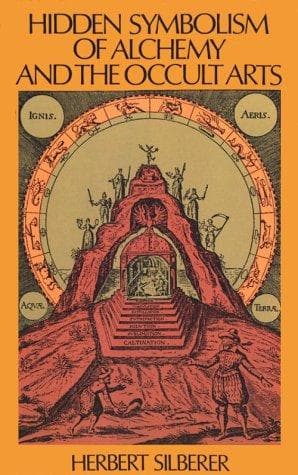
Hidden Symbolism of Alchemy and the Occult ArtsSilberer, Herbert
Religion
Hidden Symbolism of Alchemy and the Occult Arts
Silberer, Herbert
Alchemy; Society of Rosicrucians; Symbolism (Psychology)
I offer first a neat psychoanalytic interpretation of this narrative. Like
the dream, the fairy tale is regularly a phantastic fulfillment of wishes,
and, of such indeed, as we realize, but which life does not satisfy, as
well as of such as we are hardly aware of in consciousness, and would not
entertain if we knew them clearly. Reality denies much, especially to the
weak, or to those who feel themselves weak, or who have a smaller capacity
for work in the struggle for existence in relation to their fellow men.
The efficient person accomplishes in his life what he wishes, the wishes
of the weak remain unfulfilled, and for this reason the weak, or whoever
in comparison with the magnitude of his desires, thinks himself weak,
avails himself of the phantastic wish fulfillment. He desires to attain
the unattainable at least in imagination. This is the psychological reason
why so many fairy stories are composed from the standpoint of the weak, so
that the experiencing Ego of the fairy tale, the hero, is a simpleton, the
smallest or the weakest or the youngest one who is oppressed, etc. The
hero of the foregoing tale is a simpleton and the youngest. In his
phantasy, that is, in the story, he stamps his brothers, who are in real
life more efficient, and whom he envies, as malicious, disagreeable
characters. (In real life we can generally observe how suspicious are, for
instance, physically deformed people. Their sensitiveness is well known.)
Like the fox to whom the grapes are sour, he declares that what his
stronger fellows accomplish is bad, their performance of their duty
defective, and their aims contemptible, especially in the sexual sphere,
where he feels himself openly most injured. The tale treats specifically
from the outset the conquest of a woman. The carpet, the ring, are female
symbols, the first is the body of the woman, the ring is the vagina (Greek
kteis = comb = pudenda muliebria). (The carpet is still more specifically
marked as a female symbol in that the brothers take it from the body of a
shepherdess. Shepherdess—a coarse “rag”—coarse “cloth”—in contrast to the
fine carpet of the hero.)
The simpleton is one who does not like much work. When he also ascribes
negligence to his brothers he betrays to us his own nature, in that his
“feather,” i.e., himself, does not go far, while his brothers’ feathers go
some distance. In order to invalidate this view of himself the
distribution of the feathers is put off on chance, as if to a higher
determining power. This has always been a favorite excuse with lazy and
inefficient people.
One of the means of consoling himself for the unattainableness of his
wishes is the belief in miracles. (Cf. my work on Phantasy and Mythos.)
The simpleton gains his advantage in a miraculous manner; roasted pigeons
fly into his mouth.
Public-domain text, read in full here on John Shaqi.
Reviews
Reviews
No reviews yet
Be the first to share your thoughts on this work.
Elsewhere in the archive
Join the Discussion
Join the discussion
Sign in to leave a comment or review.
Sign InorCreate an account