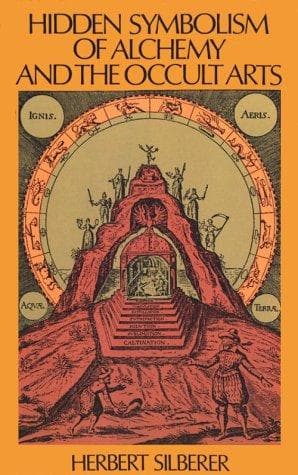
Hidden Symbolism of Alchemy and the Occult ArtsSilberer, Herbert
Religion
Hidden Symbolism of Alchemy and the Occult Arts
Silberer, Herbert
Alchemy; Society of Rosicrucians; Symbolism (Psychology)
In his erotic enterprises he sticks to his own immediate neighborhood. He
clearly bears within himself an Imago that holds him fast. [This is an
image, withdrawn from consciousness and consequently indestructible, of
the object of one’s earliest passion, which continues to operate as a
strongly affective complex, and takes hold upon life with a formative
effect. The most powerful Imagos are those of the parents. Here naturally
the mother imago comes to view, which later takes a position in the center
of the love life (namely the choice of object).] Whither does he turn for
his journey of conquest? Into the earth. The earth is the mother as a
familiar symbol language teaches us. Trap door, box, subterranean holes,
suggest a womb phantasy. The toad frequently appears with the significance
of the uterus, harmonizing with the situation that the tale presents. (On
the contrary frog is usually penis.) The toad’s big box (= mother) is also
the womb. From it indeed the female symbols, in this connection, sisters,
are produced for the simpleton. The box is, however, also the domestic
cupboard,—food closet, parcel, bandbox, chamber, bowl, etc.,—from which
the good mother hands out tasty gifts, toys, etc. Just as the father in
childish phantasy can do anything, so the mother has a box out of which
she takes all kinds of good gifts for the children. Down among the toads
an ideal family episode is enacted. The mother’s inexhaustible box (with
the double meaning) even delivers the desired woman for the simpleton.
The woman—for whom? Doubtless for the simpleton, psychologically. The tale
says for the king, because the female symbols, carpet, ring, the king
desires for himself, in so many words, and the inference is that the woman
also belongs to him. The conclusion of the tale, however, turns out true
to the psychological situation, as it does away with the king and lets the
simpleton live on, apparently with the same woman. It is clear as day that
the simpleton identifies himself with his father, places himself in his
place. The image, which possesses him from the first is the father’s
woman, the mother. And the father’s death—that is considerately
ignored—which brings queen and crown, is a wish of the simpleton. So again
we find ourselves at the center of the Œdipus complex. As
mother-substitute figures the sister, one of the little toads.
We have regarded the story first from the point of view of the
inefficiency of the hero, and have thereupon stumbled upon erotic
relations, finally upon the Œdipus complex. The psychological connection
results from the fact that those images on which the Œdipus complex is
constructed appear calculated to produce an inefficiency in the erotic
life.
The anagogic interpretation of Hitchcock (l. c., pp. 175 ff.) is as
follows, though somewhat abridged:
Public-domain text, read in full here on John Shaqi.
Reviews
Reviews
No reviews yet
Be the first to share your thoughts on this work.
Elsewhere in the archive
Join the Discussion
Join the discussion
Sign in to leave a comment or review.
Sign InorCreate an account