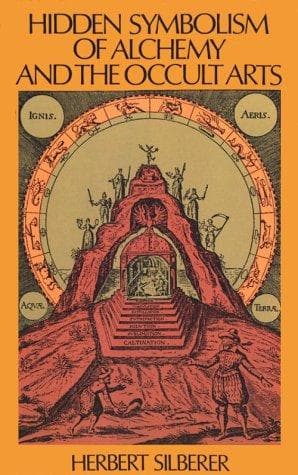
Hidden Symbolism of Alchemy and the Occult ArtsSilberer, Herbert
Religion
Hidden Symbolism of Alchemy and the Occult Arts
Silberer, Herbert
Alchemy; Society of Rosicrucians; Symbolism (Psychology)
To bring the most beautiful ring is to bring truth, which like a ring has
neither beginning nor end. Understanding and feeling go in different
directions, the simpleton waits meekly by the door that leads to the
interior of the great mother. [The appearance of this conception in the
anagogic interpretation is also important.]
In the third test, the search for “the fairest woman,” the crown of life,
conceived exoterically as well as esoterically, the carrot represents the
vegetative life (body, the natural man), and the six mice that draw it are
our old friends the six swans or virtues, and the highest of these
compassion—or love—goes as the enthroned queen in the carriage. The
uninitiated man is almost in doubt and asks, “What shall I do with a
carrot?” Yet the great mother replies, as it were, “Take one of my
fundamental forces.” And what do we see then? The toad becomes a beautiful
maiden, etc. The man now all at once realizes how fearfully and
wonderfully he is made. Filled with reverence of himself he is ready to
cry, “Not my will but thine be done.”
Still another test remains. We must all go through a sort of mystical
ring, which hangs in the hall (of learning). Only one in the whole
universe is in a condition to accomplish it, to endure it without injury.
The beautiful delicate maid with the miraculous gift is the spirit
[spiritus or [Symbol: Mercury] of alchemy].
We shall add that the two interpretations externally contradict each
other, although each exhibits a faultless finality. I should note that I
have limited myself to the briefest exposition; in a further working out
of the analysis the two expositions can be much more closely identified
with the motives of the story.
First, then, the question arises, how one and the same series of images
can harmonize several mutually exclusive interpretations (problem of
multiple interpretation); yet we have discovered in the parable three
practically equivalent schemes of interpretation, the psychoanalytic, the
chemical (scientific), and the anagogic. Secondly, the question presents
itself more particularly how can two so antithetic meanings as the
psychoanalytic and the anagogic exist side by side.
Part III.
SYNTHETIC PART.
Section I.
Introversion And Regeneration.
A. Introversion And Intro-Determination.
The multiple interpretation of works of fantasy has become our problem,
and the diametrical opposition of the psychoanalytic and the anagogic
interpretation has particularly struck us. The question now apparently
becomes more complicated if I show that the psychoanalytic interpretation
contains an analogue that we must take into consideration. The analogue is
presented by the remarkable coexistence of symbolism of material and
functional categories in the same work of imagination. In order to make
myself intelligible, I must first of all explain what these categories
are.
Public-domain text, read in full here on John Shaqi.
Reviews
Reviews
No reviews yet
Be the first to share your thoughts on this work.
Elsewhere in the archive
Join the Discussion
Join the discussion
Sign in to leave a comment or review.
Sign InorCreate an account