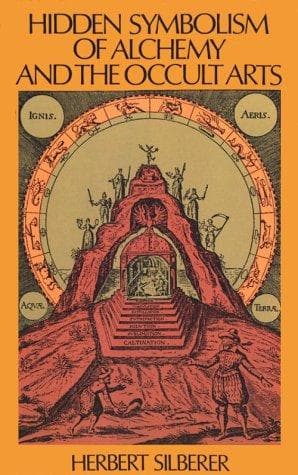
Hidden Symbolism of Alchemy and the Occult ArtsSilberer, Herbert
Religion
Hidden Symbolism of Alchemy and the Occult Arts
Silberer, Herbert
Alchemy; Society of Rosicrucians; Symbolism (Psychology)
In division 2 of the introductory part we have seen that the imagination
shows a predilection for symbolic forms of expression, proportionately
greater indeed, the more dreamlike it is. Now by this symbolism as we
observe most clearly in hypnagogic (half dreaming) hallucinations and in
dreams, three different groups of objects are represented.
I. Thought contents, imagination contents, in brief, the contents or
objects of thinking and imagining, the material of thought whether it be
conscious or unconscious.
II. The condition, activity, structure of the psyche, the way and manner
that it functions and feels, the method of functioning of the psyche,
whether it be conscious or unconscious.
III. Somatic processes (bodily stimulations). This third sort of objects
is closely coördinated with the other two. It is not capable of
interesting us in the present connection so we pass it by.
Therefore we arrive at two categories in which we can enroll all
symbolizing works of the imagination, the material and the functional.
I. The material category is characterized by its representation of thought
contents, i.e., of contents that are worked out in a train of thoughts
(arranged thought, imagined), whether they are mere images or groups of
images, concepts that are somewhat drawn out into comparisons and
definition processes, or indeed judgments, trains of reasoning, which
serve as analytic or synthetic operations, etc. Since, as we know, the
phantasies (dreams, reveries, even poems) are mostly inspired by wishes,
it will prove frequently the case that the contents symbolically contained
in them are wish images, i.e., the imagined experiencing of gratification.
II. The functional category is characterized by the fact that the
condition, structure or capacity for work of the individual consciousness
(or the psychic apparatus) is itself portrayed. It is termed functional
because it has nothing to do with the material or the contents of the act
of thinking, but applies merely to manner and method in which
consciousness functions (rapid, slow, easy, hard, obstructed, careless,
joyful, forced; fruitless, successful; disunited, split into complexes,
united, interchangeable, troubled, etc.). [It is immaterial whether these
are conscious or unconscious. Thinking must be taken here in the widest
possible sense. It means here all psychic processes that can have anything
as an “object.”]
Two typical examples will enable us at once clearly to understand the two
categories and keep them separate.
A. Material Symbolism.—Conditions. In a drowsy state I reflect upon the
nature of the judgments that are transsubjectively (= for all men) valid.
All at once the thread of the abstract thought is broken and
autosymbolically in the place of it is presented the following hypnagogic
hallucination:
Symbol. An enormous circle, or transparent sphere, floats in the air and
men are putting their heads into this circle.
Public-domain text, read in full here on John Shaqi.
Reviews
Reviews
No reviews yet
Be the first to share your thoughts on this work.
Elsewhere in the archive
Join the Discussion
Join the discussion
Sign in to leave a comment or review.
Sign InorCreate an account