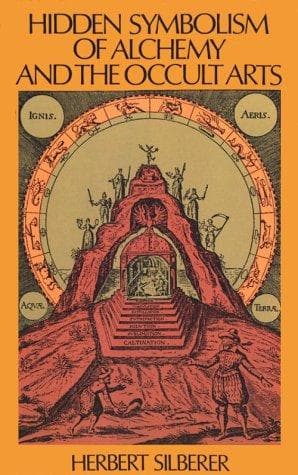
Hidden Symbolism of Alchemy and the Occult ArtsSilberer, Herbert
Religion
Hidden Symbolism of Alchemy and the Occult Arts
Silberer, Herbert
Alchemy; Society of Rosicrucians; Symbolism (Psychology)
The following may serve as a very simple case in point. Lying one evening
in bed and exhausted and about to fall asleep, I devoted my thoughts to
the laborious progress of the human spirit in the dim transcendant
province of the mothers-problem. (Faust, Part II.) More and more sleepy
and ever less able to retain my thoughts, I saw suddenly with the
vividness of an illusion a dream image. I stood on a lonely stone pier
extending far into a dark sea. The waters of the sea blended at the
horizon with an equally dark-toned mysterious, heavy air. The overpowering
force of this tangible picture aroused me from my half sleeping state, and
I at once recognized that the image, so nearly an hallucination, was but a
visibly symbolic embodiment of my thought content that had been allowed to
lapse as a result of my fatigue. The symbol is easily recognized as such.
The extension into the dark sea corresponds to the pushing on into a dark
problem. The blending of atmosphere and water, the imperceptible gradation
from one to the other means that with the “mothers” (as Mephistopheles
pictures it) all times and places are fused, that there we have no
boundaries between a “here” and a “there,” an “above” and a “below,” and
for this reason Mephistopheles can say to Faust on his departure,
“Plunge then.—I could as well say soar.”
We see therefore between the visualized image and the thought content,
which is, as it were, represented by it, a number of relations. The whole
image resolves itself insofar as it has characteristic features, almost
entirely into such elements as are most closely related to the thought
content. Apart from these connections of the material category, the image
represents also my momentary psychic condition (transition to sleep).
Whoever is going to sleep is, as it were, in the mental state of sinking
into a dark sea. (The sinking into water or darkness, entrance into a
forest, etc., are frequently-occurring threshold symbols.) The clearness
of ideas vanishes there and everything melts together just as did the
water and the atmosphere in the image.
This example is but to illustrate; it is in itself much too slight and
simple to make any striking revelation of the remarkable interlacing of
the two kinds of symbolism. I refer to my studies on symbolism and on
dreams in the bibliography. Exhaustive treatment at this point would lead
us too far afield. Let us rest satisfied then with the facts that the
psychoanalysts simultaneously deal with two fundamentally different lines
of interpretation in a product of the phantasy (dream, etc.), quite apart
from the multiple determinants which they can find within the material as
well as in the functional categories; both lines of interpretation are
supplied by the same fabric of images, indeed often by the same elements
of this image fabric. This context therefore must have been sought out
artfully enough by the creative unconscious to answer the double
requirement.
Public-domain text, read in full here on John Shaqi.
Reviews
Reviews
No reviews yet
Be the first to share your thoughts on this work.
Elsewhere in the archive
Join the Discussion
Join the discussion
Sign in to leave a comment or review.
Sign InorCreate an account