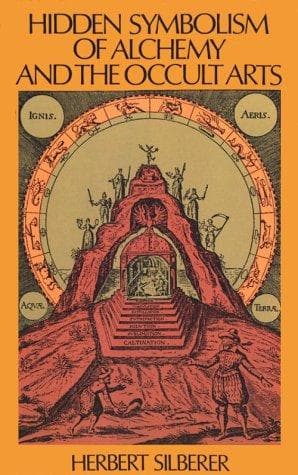
Hidden Symbolism of Alchemy and the Occult ArtsSilberer, Herbert
Religion
Hidden Symbolism of Alchemy and the Occult Arts
Silberer, Herbert
Alchemy; Society of Rosicrucians; Symbolism (Psychology)
Looking back through the elementary types, we see the infantile images
together with those non-moral origins that psychoanalysis discovers in us;
looking forward we notice thoughts directed to certain goals that will be
mentioned later. The elementary types themselves thanks to
intro-determination represent however a collection of our spiritual
powers, which we have first formed and exercised at the time that the
images arose, and which are in their nature closely related to these
images, indeed completely united with them as a result of the errors of
superposition—this collection of powers, I say, accompanies us through our
entire life and is that from which are taken the powers that will be
required for future development. The objects or applications change, the
powers remain almost the same. The symbolism of the material categories
which depends on external things changes with them; but the symbolism of
the functional categories, which reflects these powers remains constant.
The types with their intro-determination belong to the functional
categories; and so they picture the constant characters.
That experience to which the suggestions of symbolism (brought to verbal
expression by means of introversion) point as to a possible spiritual
development, corresponds to a religious ideal; when intensively lived out
this development is called mysticism. [We can define mysticism as that
religious state which struggles by the shortest way towards the
accomplishment of the end of religion, the union with the divinity; or as
an intensive cultivation of oneself in order to experience this union.] It
presents itself if instead of looking backward we gaze forward from our
elementary types to the beyond. But let us not forget that we can regard
mysticism only as the most extreme, and therefore psychically the most
internal, unfolding of the religious life, as the ideal which is hardly to
be attained, although I consider that much is possible in this direction.
If my later examination carries us right into the heart of mysticism,
without making the standpoint clear every time, we now know what
restrictions we must be prepared for.
Public-domain text, read in full here on John Shaqi.
Reviews
Reviews
No reviews yet
Be the first to share your thoughts on this work.
Elsewhere in the archive
Join the Discussion
Join the discussion
Sign in to leave a comment or review.
Sign InorCreate an account