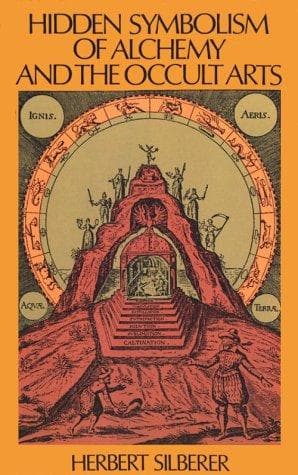
Hidden Symbolism of Alchemy and the Occult ArtsSilberer, Herbert
Religion
Hidden Symbolism of Alchemy and the Occult Arts
Silberer, Herbert
Alchemy; Society of Rosicrucians; Symbolism (Psychology)
If I take the view that those powers, whose images (generally veiled in
symbolism) are the elementary types, do not change, I do not intend to
imply that it is not possible to sublimate them. With the increasing
education of man they support a sublimation of the human race which yet
shows in recognizable form the fundamental nature of the powers. One of
the most important types, in which this transformation process is
consummated and which refines the impulse and yet allows some of its
character to remain, is the type mother, i.e., incest. Among religious
symbols we find countless incest images but that the narrow concept of
incest is no longer suited to their psychological basis (revealed through
analysis) has been, among psychoanalysts, quite clearly recognized by
Jung. Therefore in the case of every symbolism tending to ethical
development, the anagogic point of view must be considered, and most of
all in religious symbolism. The impulse corresponding to the religious
incest symbols is preeminently to be conceived in the trend toward
introversion and rebirth which will be treated of later. [Vid. note C, at
the end of the volume.]
I have just used the expression “sublimation.” This Freudian term and
concept is found in an exactly similar significance in the hermetic
writers. In the receptacle where the mystical work of education is
performed, i.e., in man, substances are sublimated; in psychological terms
this means that impulses are to be refined and brought from their baseness
to a higher level. Freud makes it clear that the libido, particularly the
unsocial sexual libido, is in favorable circumstances sublimated, i.e.,
changed into a socially available impelling power. This happens in the
evolution of the human race and is recapitulated in the education of the
individual.
I take it for granted that the fundamental character of the elementary
psychic powers in which the sublimation is consummated is the more
recognizable the less the process of sublimation is extended in time. In
mysticism, e.g., the fundamental character penetrates the primal motive
because the latter wishes to lead the relatively slightly sublimated
impulses by a shortened process to the farthest goal of sublimation.
Mysticism undertakes to accomplish in individuals a work that otherwise
would take many generations. What I said therefore about the
unchangeability of the fundamental powers or their primal motive, is
wholly true of its fate in mystical development.
The Mohammedan mystic Arabi (1165-1240) writes, “Love as such, in its
individual life, is the same for sensuous and spiritual, therefore equally
for every Arab (of an allegory) and for me, but the objects of love are
different. They loved sensible phenomena while I, the mystic, love the
most intimate existence.” (Horten, Myst. Texte, p. 12.)
Public-domain text, read in full here on John Shaqi.
Reviews
Reviews
No reviews yet
Be the first to share your thoughts on this work.
Elsewhere in the archive
Join the Discussion
Join the discussion
Sign in to leave a comment or review.
Sign InorCreate an account