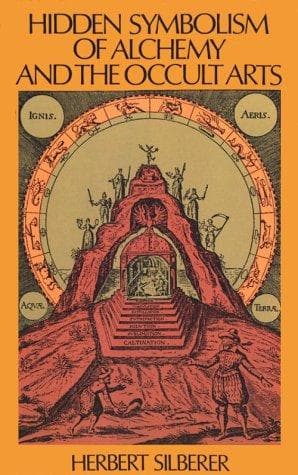
Hidden Symbolism of Alchemy and the Occult ArtsSilberer, Herbert
Religion
Hidden Symbolism of Alchemy and the Occult Arts
Silberer, Herbert
Alchemy; Society of Rosicrucians; Symbolism (Psychology)
The primal tendencies, when directed toward the persons in the
environment, produce certain typical phenomena. I can unfortunately
describe them only with expressions which, if the cultured man uses them,
evoke the idea of crime. An ethically colorless language should be made
available for these things. [The dream and the myth have found for them
the language of symbolism.] The opposition of a fellow man against the
working out of an impulse arouses a tendency to overcome this man, to get
him out of the way, to kill him. The type of the obstructing man is always
the instructor (father, eventually mother). That he is at the same time a
doer of good is less appreciated because the psychical apparatus takes the
satisfaction of desires as the natural thing, which does not excite its
energy nearly as much as does a hindrance to its satisfaction.
[Recognition of a good deed, thankfulness, etc., regularly presuppose
sublimation; they do not belong to the titanic aspect. A form of
appreciation of this kindness however comes to mind. Towards the mother
there occurs on the part of the child, though it has been completely
overlooked for a long time, very early and gradually increasing, a
sexually-toned feeling, although the manifestations of this feeling are
very dim and at times may completely disappear. In this “love” is
contained a germ of desire, of erotic appropriation-to-self. Any woman in
the environment and especially the mother must needs supply the ideal of
the desired woman. In so far as the father is perceived as an obstacle to
the love towards the mother he must, in the elementary tendency, be killed
to remove the obstacle, and there arises the murder impulse belonging to
the Œdipus Complex. [The child has no clear idea of death. It is only a
matter of wishing to have some one out of the way. If this primal motive
appears to us subsequently as a “killing,” it is again only because of the
error of superposition, just as in the later mentioned “rape.”] In so far
as the mother herself does not meet the desired tenderness or in refusing,
acts as a corrective agent, while carrying on the education, she, too,
becomes an obstacle, a personality contrasting with the “dear” mother, a
contrast which plunges the psyche in anxiety and bitterness. Anxiety comes
principally from the conflict of psychical tendencies, which result from
the same person being both loved and hated. The correlative to the denying
action of the mother is to commit rape on her. Another cause of the
attraction towards the mother besides the erotically toned one, is the
desire for her care, called forth by the hardships encountered elsewhere
in the world. It is an indolence opposed to the duties of life. The
propensity towards ease is psychologically a very important factor. The
home is in general the place of protection; the characteristic embodiment
of this is preëminently the mother. We speak of maternal solicitude but
less of paternal solicitude.
Public-domain text, read in full here on John Shaqi.
Reviews
Reviews
No reviews yet
Be the first to share your thoughts on this work.
Elsewhere in the archive
Join the Discussion
Join the discussion
Sign in to leave a comment or review.
Sign InorCreate an account