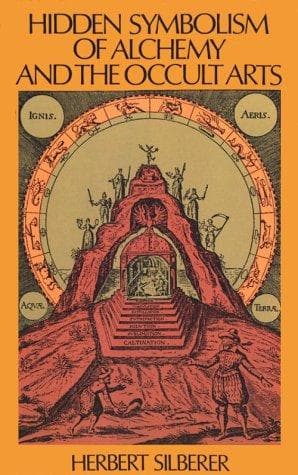
Hidden Symbolism of Alchemy and the Occult ArtsSilberer, Herbert
Religion
Hidden Symbolism of Alchemy and the Occult Arts
Silberer, Herbert
Alchemy; Society of Rosicrucians; Symbolism (Psychology)
As for the nature of the relatively unchangeable spiritual tendencies
represented by the elementary types [That can also be called in
mythological study primal motives] a simple examination of the essentials
without any psychological hair splitting, brings us at once to an
elementary scheme that will help us to understand the changes
(intro-determination) that take place in accordance with the elementary
types. We need here only to examine the simplest reactions of the
individual, necessarily produced by rubbing up again the external world;
reactions which become persistent forms of experience that are
approximately as self-evident as the libido itself. The degree of egoism
which is active in the elementary tendencies must, according to the
experience of psychoanalysis, be considered very great. For this purpose I
have selected in what follows an excessively egotistical expression for
the “titanic” aspect, the retrospective form, of the tendencies; and this
same excessive expression which would seem to be rather objectionable when
applied to the basis of a religious development, enables us, thanks to the
principle of intro-determination, to understand this development.
Starting from the libido in the most general sense we arrive first of all
at the two phenomena, the agreeableness and the disagreeableness, from
which results at once, acceptance and aversion. Obstacles may aggravate
both activities, so that acceptance becomes robbery and aversion becomes
annihilation. These possibilities can to be sure only become acts in so
far as they prove practically feasible. In all cases they are present in
the psyche, and in this crude primal form play no small part in the soul
of the child. It is indeed only a blind sentimentality that can raise the
child to an angelic status, from which it is as far removed as from its
opposite. We should be careful not to regard the crude form of the impulse
as crude in the sense of an educated humanity, which must see in the
crudeness something morally inferior. In robbery and annihilation there
exists on the primitive or childish level hardly the slightest germ of
badness. There is much to be said about the psychology and morality of the
child. I cannot, however, enter very deeply into this broad topic,
interesting though it is.
Public-domain text, read in full here on John Shaqi.
Reviews
Reviews
No reviews yet
Be the first to share your thoughts on this work.
Elsewhere in the archive
Join the Discussion
Join the discussion
Sign in to leave a comment or review.
Sign InorCreate an account