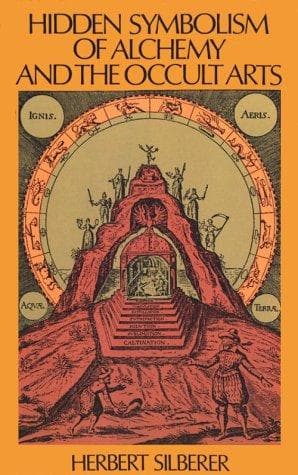
Hidden Symbolism of Alchemy and the Occult ArtsSilberer, Herbert
Religion
Hidden Symbolism of Alchemy and the Occult Arts
Silberer, Herbert
Alchemy; Society of Rosicrucians; Symbolism (Psychology)
In many of the modern theosophic introversion methods, borrowed from the
Hindu yoga doctrines, we find the exhortation to attach no importance to
the marvels appearing beside the real prize, indeed to regard them as a
pernicious by-product. The Hindu doctrine calls them Siddhi. Walter Hitton
speaks of them as “inferior subordinate matters.” From the description of
them it appears that they are phantastic appearances, which partly flatter
the wish for power, partly other wishes. [See Note E at the end of this
volume.] The Siddhi are qualified to captivate weak minds with their
jugglery. Erotic experiences are connected very easily with them because,
going over into the regressive phase, they show their “titanic”
countenances. I have with some daring, but not without right, just cited
the Siddhi as the anagogic equivalent of autoerotism. The regressive
phase, however, appears as soon as one indulges in the gratification of
the Siddhi. It is not the Siddhi themselves that are the evil (I regard
them indeed as anagogic), but the losing of oneself in them. They can be
both divine and diabolic. That depends on one’s attitude towards them.
In the result of introversion, the diabolic mysticism is opposed, as we
saw, to the divine. The true mysticism is characterized by the extension
of personality and the false by the shrinking of personality. We can also
say, by an extension or shrinking of the sphere of interest that
determines the socially valuable attitude. I say advisedly “sphere of
interest,” for mysticism in the end will not merely fulfill the social law
without love, but it labors for the bringing out of this very love. It is
not satisfied with superficially tincturing the substance into gold (i.e.,
among other meanings, to get man to do good externally); but it would
change the substance completely, make it gold through and through (i.e.,
to orient the entire impulse power of man for good, so that he desires
this good with the warmth of love and therefore finds his good fortune in
virtue). Only the good and not the good fortune is chosen as the leading
star, as I must note in order to avoid a misconception about the hermetic
procedure. Happiness arises only at a certain point, and seems to me like
a fruit ripened in the meantime. The most subtle representatives of this
doctrine among the alchemists are not so far, after all, from the Kantian
ethics.
Alchemistic ethics presupposes that there is an education, an ennobling of
the will. The person that wills can learn to encompass infinitely much in
his ego. [Cf. Furtmüller (Psychoanalyse und Ethik, p. 15): “The individual
can ... make the commands of others his own.” He quotes Goethe (Die
Geheimnisse):
From the law which binds all being
The man is freed who masters himself.
Public-domain text, read in full here on John Shaqi.
Reviews
Reviews
No reviews yet
Be the first to share your thoughts on this work.
Elsewhere in the archive
Join the Discussion
Join the discussion
Sign in to leave a comment or review.
Sign InorCreate an account