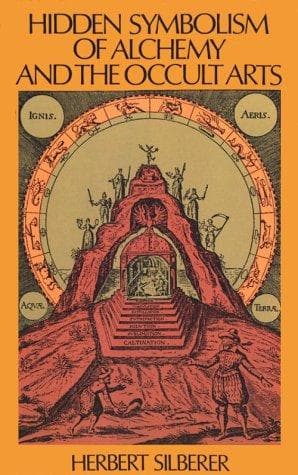
Hidden Symbolism of Alchemy and the Occult ArtsSilberer, Herbert
Religion
Hidden Symbolism of Alchemy and the Occult Arts
Silberer, Herbert
Alchemy; Society of Rosicrucians; Symbolism (Psychology)
The poles of shrinking and extension are the following: The magician and
the pathological introversionist contract the sphere of their interest
upon the narrowest egoism. The mystic expands it immensely, in that he
comprises the whole world in himself. The person egotistically entering
into introversion can preserve his happiness only by a firm self-enclosure
before the ever threatening destruction; the mystic is free. The mystic’s
fortune consists in the union of his will with the world will or as
another formula expresses it, in the union with God. [On the freeing
effect of the merging of one’s own will into a stronger cf. my essays Jb.
ps. F., III, pp. 637 ff., and IV, p. 629.] This fortune is therefore also
imperishable (gold). The reader must always bear in mind that the mystic
never works on anything but on the problem of mankind in general; only he
does so in a form of intensive life, and it may indeed be the case that
the powers which introversion furnish him, actually make possible a more
dynamic activity and a greater result. For my part I am strongly inclined
to believe it.
On the extension of personality, some passages from the Discourses on
Divinity in the Bhagavad-Gita:
“Who sees himself in all being and all being in himself,
Whoever exercises himself in devotion and looks at all
impartially,
Whoever sees me everywhere, and also sees everything in me,
From him I can never vanish nor he from me.” VI, 29f.
“Whoever discovers in all the modes of life the very exalted lord,
Who does not fail when they fail—he who recognizes that, has
learned well,
For whosoever recognizes the same lord as the one who dwells in
all,
Wounds not the self through the self, and travels so the highest
road.” XIII 27f.
These passages elucidate the progressive function of the idea of God in
the “work.” Incidentally, I believe that the devotional doctrines (Yoga)
which are theoretically based on the Samkhya philosophy that originated
without a God, has for good practical reasons taken the idea of isvara
(God) into its system. Concentration requires an elevated impalpable
object as an aim. And this object must have the property of being above
every reach of the power to grasp and yet apparently to seem attainable.
God has furthermore the functions of the bearer of conflicts and hopes. At
the beginning of the work indeed the obstructing conflicts still exist. A
certain unburdening is accomplished by leaving the conflict to the
divinity, and frees the powers that were at first crippled under the
pressure of the conflicts. [Cf. Jung’s Psychology of the Unconscious,
Freud Kl. Schr., II, p. 131.]
Public-domain text, read in full here on John Shaqi.
Reviews
Reviews
No reviews yet
Be the first to share your thoughts on this work.
Elsewhere in the archive
Join the Discussion
Join the discussion
Sign in to leave a comment or review.
Sign InorCreate an account