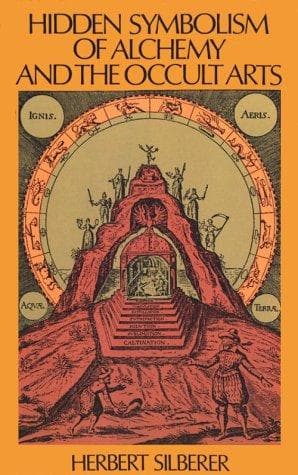
Hidden Symbolism of Alchemy and the Occult ArtsSilberer, Herbert
Religion
Hidden Symbolism of Alchemy and the Occult Arts
Silberer, Herbert
Alchemy; Society of Rosicrucians; Symbolism (Psychology)
In the domestication of man through countless generations, social
instincts must have been established, which appear as moral dispositions.
I recall the moral feeling in Shaftesbury. The social life of man, for
instance, plays with Adam Smith a significant rôle, and yet even with him
the moral law is not something ready from the very beginning, not an
innate imperative, but the peculiar product of each individual. The
development of conscience receives an interesting treatment by Smith.
There takes place in us a natural transposition of feelings, mediated
through sympathy, which arouse in each of us the qualities of the other,
and we can say “that morality in Smith’s sense, just as Feuerbach taught
later, is only reflected self-interest, although Smith himself was quite
unwilling to look at sympathy as an egotistic principle. By means of a
process that we can almost call a kind of self-deception of the
imagination, we must look at ourselves with the eyes of others, a very
sensible precaution of nature, which thus has created a balance for
impulses that otherwise must have operated detrimentally. [Bear in mind
what I have said above about intro-determination.] This transposition
which sympathy effects we cannot escape; it itself appears when we know
that we are protected from the criticism of another by the complete
privacy of our own doings. It alone can keep us upright when all about us
misunderstand us and judge us falsely. For the actual judgments of another
about us form, so to speak, a first court whose findings are continually
being corrected by that completely unpartisan and well informed witness
who grows up with us and reacts on all our doings.” (Jodl., l. c., I, pp.
372 ff.)
The derivation of the moral from selfish impulses by transposition does
not resolve ethics into egoism, as Helvetius would have us believe. It is
“a caricature of the true state of things to speak of self-interest, when
we have in mind magnanimity and beneficence, and to maintain that
beneficence is nothing but disguised selfishness, because it produces joy
or brings honor to the person that practices it.” (L. c., p. 444.)
The ethical evolution which takes place as an extension of personality
demands, the more actively it is practiced, the removal of resistances
which operate against the expansion of the ego. It cannot be denied that
hostile tendencies, which are linked with pusillanimous views, are always
on hand and create conflicts. If they were not, the moral task would be an
easy one. Now as man cannot serve two masters, so in the personal
psychical household, the points of view which have been dethroned, as far
as they will not unite with the newly acquired ones, must be killed, and
ousted from their power. Most of all must this process be made effective
if the development is taken up intensively in the shape of introversion.
It must appear also in the symbolism.
Public-domain text, read in full here on John Shaqi.
Reviews
Reviews
No reviews yet
Be the first to share your thoughts on this work.
Elsewhere in the archive
Join the Discussion
Join the discussion
Sign in to leave a comment or review.
Sign InorCreate an account