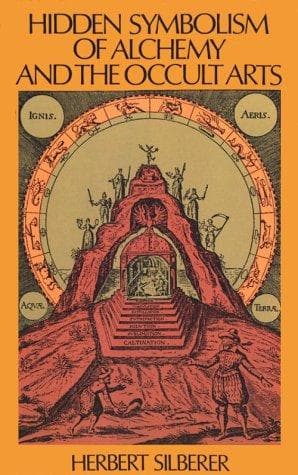
Hidden Symbolism of Alchemy and the Occult ArtsSilberer, Herbert
Religion
Hidden Symbolism of Alchemy and the Occult Arts
Silberer, Herbert
Alchemy; Society of Rosicrucians; Symbolism (Psychology)
To the functional symbolism of actual forces belong, e.g., in large part
the faces in my lecanomantic experiments, although they also contain
program material; further, in purest form, the previously related
autosymbolic vision of the mountains. The progress of a psychoanalytic
treatment is, apart from the program connections, generally copied in the
dream in correspondence to the momentary psychic status, and therefore
actually and functionally. It is quite probable that the progress of the
mystical work is represented to the mystic in his phantasying (dreams,
visions, etc.) in a symbolic manner. But when one happens upon written
phantasy products of the mystics, of course only he who has mystical
experiences of his own can venture to say whether a program symbolism or
an actually functional symbolism is exhibited. For example, I make no
judgment on the degree of actuality in the anagogic symbolism of the
parable.
C. Regeneration.
In the favorable issue of introversion, i.e., when we conquer the dragon,
we liberate a valuable treasure, namely, an enormous psychic energy, or,
according to the psychoanalytic view, libido, which is applicable to the
much desired new creation (as the titanic aspect of which we recognize the
“reforming”). The symbolic type, either openly or hiddenly expressed, of
the setting free of an active libido, is birth. A libido symbol with the
characteristic of active life comes out of a mother symbol. (The former is
either explicitly a child or even a food, or it is phallic or animal. Zbl.
Psa., III, p. 115.) As the mystic is author of this, his birth, he has
become his own father.
Introversion (seeking for the uterus or the grave) is a necessary
presupposition of regeneration or resurrection, and this is a necessary
presupposition of the mystical creation of the new man. (John III, 1-6):
“There was a man of the Pharisees named Nicodemus, a ruler of the Jews.
The same came to Jesus by night [introversion] and said unto him, ‘Rabbi,
we know that thou art a teacher come from God; for no man can do these
miracles that thou doest except God be with him.’ Jesus answered and said
unto him, Verily, verily, I say unto thee, Except a man be born again, he
cannot see the kingdom of God. Nicodemus saith unto him, How can a man be
born when he is old? Can he enter the second time into his mother’s womb
and be born? Jesus answered, Verily, verily, I say unto thee, Except a man
be born of water and of the Spirit, he cannot enter into the kingdom of
God. That which is born of the flesh is flesh, that which is born of the
Spirit is spirit.”
Water is one of the most general religious mother symbols (baptism). With
the earliest alchemists the brazen man becomes silver, the silver man,
gold, by being dipped in the holy fountain.
A mythological representation of introversion with its danger and with
regeneration was given previously [see Vishnu’s adventure]. Detailed
examples follow; first the Celtic myth of the birth of Taliesin.
Public-domain text, read in full here on John Shaqi.
Reviews
Reviews
No reviews yet
Be the first to share your thoughts on this work.
Elsewhere in the archive
Join the Discussion
Join the discussion
Sign in to leave a comment or review.
Sign InorCreate an account