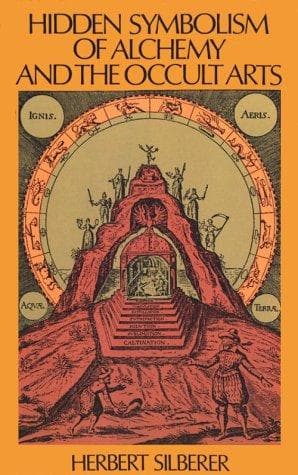
Hidden Symbolism of Alchemy and the Occult ArtsSilberer, Herbert
Religion
Hidden Symbolism of Alchemy and the Occult Arts
Silberer, Herbert
Alchemy; Society of Rosicrucians; Symbolism (Psychology)
by Schlegel: German [Schroeder].)
“Wer wie das Meer in das die Wasser strömen
Das sich anfüllet und doch ruhig dasteht
Wer so in sich die Wünsche lässt verschwinden,
Der findet Ruhe—nicht wer ihnen nachgibt.”
Above I have compared the lion of the parable to the Sphinx of Œdipus, and
on the other hand, it appears from later deliberation that it (the lion)
must be the retrogressive element in men, which is to be sacrificed in the
work of purification. Now I find several remarks of Jung (Psychology of
the Unconscious) that mediate very well between both ideas. Even if I do
not care to go so far as to see in the animal only the sexual impelling
powers, but prefer to regard it rather as the titanic part of our
impulses, I find the conception of the author very fortunate. The Sphinx,
that double being, symbolizes the double natured man, to whom his
bestiality still clings. Indeed it is to be taken exactly as a functional
representation of the development of reason out of the impulses (human
head and shoulders growing out of an animal body).
The homunculus motive would likewise have to be regarded in a new light. I
have said that the mystic was his own father; he creates a new man
(himself) out of himself with a merely symbolic mother, therefore with
peculiar self-mastery, without the coöperation of any parents. That means
the same thing as the artificial creation of a man. We recognize therefore
the anagogic significance of the homunculus, the idea of which we found
closely interwoven with alchemy in general. This connection also has not
escaped Jung, though he takes it one-sidedly and draws a too far-reaching
conclusion. He points to the vision of Zosimos, where, in the hollow of
the altar he finds boiling water and men in it, and remarks that this
vision reveals the original sense of alchemy, an original impregnation
magic, i.e., a way in which children could be made without a mother. I
must observe that the hermetic attempt to get back to Adam’s condition has
some of the homunculus phantasy in it. Adam was regarded as androgyne, a
being at once man and woman, but sufficient in himself alone for
impregnation and procreation. Welling says in his Opus mago-cabbalisticum,
“This man Adam was created, as the scripture says, i.e., of the male and
female sex, not two different bodies but one in its essence and two in its
potentiality, for he was the earth Adamah, the red and white [Symbol:
Sulfur] the spiritual [Symbol: Gold] and [Symbol: Silver], the male and
female seed, the dust of the Adamah from Schamajim, and therefore had the
power to multiply himself magically (just as he was celestial) which could
not indeed have been otherwise, unless the essential masculinity and
femininity were dissociated.” I am reminded in this connection that
Mercury is also bisexual; the “materia” must be brought into the
androgynic state “rebis.” The idea of hermaphroditism plays a well known,
important part in mythology also.
Public-domain text, read in full here on John Shaqi.
Reviews
Reviews
No reviews yet
Be the first to share your thoughts on this work.
Elsewhere in the archive
Join the Discussion
Join the discussion
Sign in to leave a comment or review.
Sign InorCreate an account