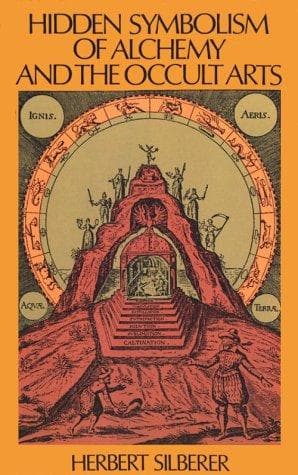
Hidden Symbolism of Alchemy and the Occult ArtsSilberer, Herbert
Religion
Hidden Symbolism of Alchemy and the Occult Arts
Silberer, Herbert
Alchemy; Society of Rosicrucians; Symbolism (Psychology)
* * * * *
We have explained why phantasy creations carry two meanings, the
psychoanalytic and the anagogic, apparently fundamentally different, even
contradictory, and yet, on account of their completeness, undeniable. We
have found that the two meanings correspond to two aspects or two
evolutionary phases of a psychic inventory of powers, which are attached
as a unity to symbolic types, because an intro-determination can take
place in connection with the sublimation of the impulses. When we
formulated the problem of the multiple interpretation, we were struck with
the fact that besides the two meanings that were nominally antipodal in
ethical relations, there was a third ethically indifferent, namely, the
natural scientific. Apart from the fact that I have not yet exhausted the
anagogic contents of our material and so must add a number of things in
the following sections, I am confronted with the task of elucidating the
position of the nature myth portion. That will necessarily be done
briefly.
In the case of alchemy the natural scientific content is chemistry (in
some degree connected with physics and cosmology), a fact hardly requiring
proof. The alchemistic chemistry was not, to be sure, scientific in the
strict modern sense. In comparison with our modern attitudes it had so
much mythical blood in it that I could call it a mythologically
apperceiving science, wherein I go a little beyond the very clearly
developed conception of Wilhelm Wundt (Volkerps. Myth. u. Rel.) regarding
mythological apperception, from a desire for a more rigid formulation, but
without losing the peculiar concept of the mythical or giving it the
extension it has acquired with G. F. Lipps. Alchemy’s myth-like point of
view and manner of thinking is paralleled by the fact that it was
dominated by symbolic representation and the peculiarities that go with
it. [The concept of the symbol is here to be taken, of course, in the
wider sense, as in my papers on Symbolbildung (Jb. ps. F., II-IV).]
Public-domain text, read in full here on John Shaqi.
Reviews
Reviews
No reviews yet
Be the first to share your thoughts on this work.
Elsewhere in the archive
Join the Discussion
Join the discussion
Sign in to leave a comment or review.
Sign InorCreate an account